REPORT

State of AI Adoption in Insurance
2026

Dive into the AI trends setting the pace for insurance


State of AI Adoption in Insurance 2026
 

Download Now


Insurers believe in AI
and are moving from

Exploration to Execution

Insurers are actively deploying AI across underwriting, claims, and operations.

This second annual State of AI Adoption in Insurance takes a clear-eyed look at how insurers are putting AI to work today. It highlights where momentum is building, where progress is slowing, and what continues to separate experimentation from measurable operational impact.

Based on survey responses from insurance professionals across underwriting, claims, servicing, IT, and operations, the report reflects how AI is being evaluated, tested, and deployed in real insurance environments, providing a grounded, real-world view of AI adoption across the industry.

More than a snapshot of trends, this report serves as a practical benchmark. Whether your organization is exploring use cases, validating solutions, or running AI in production, the findings help assess readiness, identify gaps, and pressure-test priorities against peers. It’s built to support smarter decisions as AI shifts from isolated initiatives to an expected, scalable capability within insurance operations.

Use this report to:

Benchmark your AI adoption against peers across underwriting, claims, and servicing

Understand which AI use cases are delivering real operational value today

Clarify what it takes to move AI from exploration into production

Learn how leading insurers are overcoming data, security, and ROI challenges

See how insurers are designing AI with human oversight and governance built in

Apply proven best practices to move AI initiatives from pilots into scalable execution

State of AI Adoption in Insurance 2026
 

What’s Included

State of AI Adoption in Insurance 2026 report cover
  • Executive Summary
  • Key Findings
  • Survey Results
  • AI Adoption Areas
  • Confidence in Value
  • Critical AI Success Factors
  • AI Solution Selection Criteria
  • AI Adoption Maturity
  • AI Exploration Progress
  • AI Testing in Practice
  • AI Production Rollout
  • Sources of AI Hesitation
  • Formalizing AI Governance
  • Barriers to AI Adoption
  • Trending Priorities & Use Cases
  • Recommendations & Best Practices
 
Key Findings — State of AI Adoption in Insurance

Key Findings

1

AI is now the norm across the insurance industry

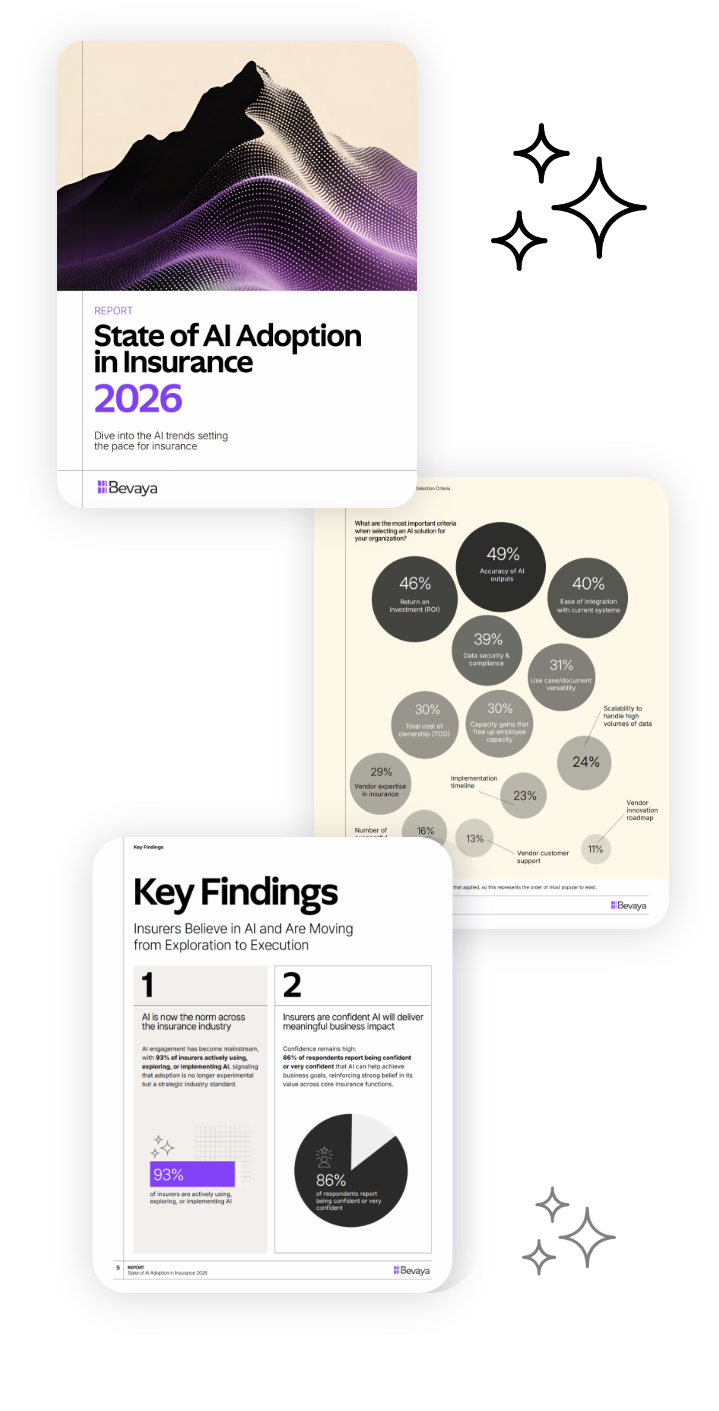
AI engagement has become mainstream, with 93% of insurers actively using, exploring, or implementing AI, signaling that adoption is no longer experimental but a strategic industry standard.

93%

of insurers actively using, exploring, or implementing AI

2

Insurers are confident AI will deliver meaningful business impact

Confidence remains high: 86% of respondents report being confident or very confident that AI can help achieve business goals, reinforcing strong belief in its value across core insurance functions.

3

AI is delivering the fastest wins in repetitive, document-heavy workflows

Automation leads adoption (53%), with unstructured document processing (46%) and copilots (45%) close behind, showing that operational relief in high-volume workflows remains AI’s clearest near-term payoff.

53%Automationleadsadoption46%Unstructureddocumentprocessing45%Copilots
4

AI maturity is accelerating from exploration into testing and production

Insurers are moving into execution: 58% are now either testing AI (31%) or running solutions in production (27%), marking a clear shift from evaluation to operational deployment and highlighting an emerging gap between leaders and laggards.

31% Testing AI 27% AI Production 58% Moving toAI execution
5

Insurers define AI success through accuracy, oversight, and measurable business outcomes

Accuracy of AI outputs (51%), human oversight (41%), and alignment to measurable business goals (40%) rank as the most critical success factors, showing that scalable AI adoption will depend on reliability, accountability, and clear KPI-driven value within regulated workflows.

Clear alignment tomeasurable businessgoals/outcomes40%Allowing AI decisionsto be made but withhuman oversight41%Accuracy of AI outputs51%
6

Insurers’ AI barriers highlight the need for stronger data and governance

Insurers are moving beyond skepticism into practical implementation, with data quality (51%), security and privacy (48%), and unclear ROI (40%) emerging as the top barriers, reinforcing that continued AI progress will be driven by stronger data foundations, governance, and measurable business value.

UnclearROI40%Security&Privacy48%DataQuality51%
7

Governance is emerging as a key marker of AI readiness

Nearly three-quarters of insurers (73%) have an AI governance committee established or in progress, signaling that formal oversight is becoming essential for responsible adoption and highlighting a divide with the 25% who have no defined plans.

73% Have an AI governancecommittee established or inprogress 25% Have no definedplans
 

Trending Priorities
& Use Cases

Insurers prioritize decision-support AI in core operations to drive efficiency, speed, and cost control

Underwriting

Top Priorities

What are the top 3 outcomes related to underwriting you hope to achieve with AI adoption in the coming 12 months?

Insurers are under pressure to scale without adding headcount, making automation and AI a priority for reducing submission friction and improving throughput.

In competitive segments like small commercial and workers’ compensation, speed-to-quote affects placement outcomes directly, making operational efficiency a growth lever, not just a cost play.

1 Improve operational efficiency through automation
2 Increase premium growth
3 Increase speed to quote

Top Use Cases

What are the top 3 AI use cases your organization is actively exploring or implementing within underwriting?

1 Underwriting submission document processing & data extraction
2 Underwriting risk scoring & risk appetite segmentation
3 Creating summaries of submission documents and files

Real Examples

  • Submission Intake
  • Loss Runs
  • Supplemental Applications
  • Schedules and SOVs
  • ACORD Forms
  • Policy Renewals
Claims Management

Top Priorities

What are the top 4 outcomes related to claims you hope to achieve with AI adoption in the coming 12 months?

Claims organizations face sustained pressure to reduce cycle times and control loss adjustment expenses while managing high volumes of unstructured data.

Manual handoffs and siloed systems compound intake delays and drive rework.

AI is expected to accelerate document handling, triage, and information access, while adjusters retain accountability for coverage decisions and customer communication, where speed and clarity directly shape retention.

1
Improve document processing and handling times
2
Improve claims processing efficiency
3
Reduce claims cycle times
4
Improve customer experience/ satisfaction

Top Use Cases

What are the top 3 AI use cases your organization is actively exploring or implementing within claims?

1 Claims document processing & data extraction
2 Creating summaries of claims documents and files
3 Predictive claims analytics

Real Examples

  • Claims Indexing
  • Claims Handling
  • FNOL/FROI Setup
  • Legal Demands
  • Claims Summaries
  • Medical Bills
  • ACORD Forms
Policy Servicing and Operations

Top Priorities

What are the top 3 outcomes related to claims you hope to achieve with AI adoption in the coming 12 months?

Policy servicing operations face pressure to absorb rising transaction volumes across endorsements, renewals, invoicing, and document management without scaling staff or spend alongside them.

Manual processing and fragmented workflows create operational burden and rework across the policy lifecycle.

AI is being positioned to reduce variability, stabilize execution, and scale routine servicing work while maintaining accuracy and control.

1 Reduce operational costs
2 Improve operational efficiency through automation
3 Introduce AI into (or scaling across) the business

Top Use Cases

What are the top 3 AI use cases your organization is actively exploring or implementing within policy servicing and operations?

1 Customer-facing chatbots and virtual assistants
2 Personalized customer communications
3 Automated endorsement requests processing

Real Examples

  • Premium Audit
  • COI Creation
  • Endorsement Processing
  • Invoice Payments
 

Recommendations& Best Practices

Establish clear ownership and executive accountability

Align AI investments to business outcomes and measurable value

Build cross-functional governance and operating alignment early

Design human oversight into core workflows

Prepare the workforce through role clarity and change management

Use proofs of value as structured decision points

Strengthen data readiness through use-case driven scope

Recognize that not all AI is the same

Operationalize continuous monitoring and feedback loops in production

State of AI Adoption in Insurance 2026


Download Now

Share