



Webinar
How to Implement AI in Insurance: 9 Best Practices (2026)
Chaz Perera walks through nine best practices that help insurers move AI from pilot to production and scale it across underwriting, claims, and policy servicing.

Video not playing? Switch video player.
About this session
Most insurers have moved past asking whether AI matters. The harder questions start once AI goes into production: who owns it, how you measure it, how you control it, and how you scale it. In this webinar, Chaz Perera, Co-Founder and CEO of Bevaya, walks through nine best practices for building that foundation, with Bevaya's Jill Zakarian hosting.
This session is for carrier, MGA, and TPA leaders and the operations teams responsible for AI in underwriting, claims, and policy servicing. Chaz covers executive ownership, tying AI to measurable outcomes, cross-functional governance, human oversight, role clarity, structured proofs of value, practical data readiness, choosing AI built for insurance, and continuous monitoring. The Q&A covers where to start, build versus buy, proving ROI, governance for a midsize carrier, frontline adoption, and moving a pilot into production.
Why it matters. The insurers getting real value from AI are the ones building most deliberately. A solid foundation is what turns one successful workflow into many.
What you'll learn
Put a business owner in charge
AI needs an owner in operations and an executive accountable for moving it into production.
Start with high-volume manual work
Submission intake, FNOL intake, and certificate issuance show results fastest and build trust early.
Build human oversight into the workflow
AI prepares the work, thresholds flag low-confidence outputs, and people make the final call.
End every pilot with a decision
Set success criteria and a timeline up front, then proceed, adjust, or stop.
Full transcript
Why AI in insurance needs a deliberate foundation
Jill Zakarian, BevayaThrilled to be joined by our co-founder and CEO, Chaz Perera. Today, Chaz will walk us through nine best practices for standing up AI in insurance. Whether you're just getting started or already testing things out, he'll cover the areas that matter most to make it successful. So, without further ado, I'm happy to hand things over to you, Chaz. Take it away.
Chaz Perera, BevayaAwesome. Thank you, Jill. Okay, so today's session is built around one idea. How to build a solid foundation for AI in insurance.
And that's intentional because what we're seeing across the industry is that the organizations getting real value from AI are not the ones moving the fastest. They're the ones building the most deliberately. AI is not a one-time implementation. It's not a project with a start and end date.
It's an operational capability. And like any operational capability, it requires structure, discipline, and the right foundation to be successful and to later scale. If that foundation isn't built correctly, everything on top of it becomes harder to sustain. So today, we're going to talk we're going to walk through that what that foundation looks like, not in theory, but in practical terms that you can take back into your organizations.
Generative AI vs agentic AI
Chaz Perera, BevayaBefore we go further, it's important to level set on what we mean when we say AI because not all AI is the same. Most of what people are talking about today is generative AI. That's the ability to create content, text, messages, and code. It's powerful, but it's not designed to do the work that agentic agentic AI is different.
It's goal-driven. It takes that same intelligence and applies it to complete tasks, make make decisions, and move work forward. It doesn't just generate an answer. It actually executes.
And that distinction matters because the the opportunity in insurance is not just generating content. It's improving how work gets done across underwriting, claims, and operations. And that's what we're going to focus on today.
AI in insurance is now operational
Chaz Perera, BevayaAI is no longer experimental. It's operational. We've recently released our "State of AI Adoption in Insurance" 2026 report that is packed with data that we collected and analyzed to provide a picture of how insurers are approaching AI this year. We found that across the industry over 90% of insurers are already using exploring or implementing AI and more than 80% are confident it will deliver business value.
That tells us something. This is not an industry debating whether AI matters. That question has been answered. What we're seeing is is a shift.
Organizations are moving from explor exploration to execution, from curiosity to deployment. And that's where the real challenges begin because once AI moves the produ into production, the questions change. It's no longer about what can AI do. It's it's about how we implement it how you control it and how you scale it.
1. Ownership and executive accountability for AI
Chaz Perera, BevayaThe first best practice is about ownership and accountability. AI is not AI cannot live as an experiment inside IT or innovation teams. It has to be owned by the business because ultimately the outcomes are business outcomes. That means assigning clear ownership within operations.
Who is responsible for the use case, the performance and the results. But ownership alone is not enough. It also requires executive accountability. Someone at the leadership level needs to ensure that initiatives move forward, that decisions are made and that successful use cases actually scale.
Without that, you tend to see fragmentation, multiple pilots, disconnected efforts, and no clear path to production. Ownership defines who is responsible. Accountability ensures it's actually it actually gets done. And you need both to move from experimentation to execution.
This is how you operationalize ownership and accountability. Start with a business owner, not IT, not innovation, someone within operations who is responsible for the outcomes. Next, define decision rights. Who approves pilots?
Who approves funding? And most importantly, who decides when something moves into production? Then establish a governance structure, a consistent forum where initiatives are reviewed, prioritized, and evaluated. Without that, decisions get delayed and progress slows down.
Set success criteria up front before anything is deployed. Define what success looks like, whether it's accuracy, ROI, or workflow impact. And finally, create visibility. Performance, risk, and outcomes need to be visible to leadership on a on a consistent basis because visibility drives accountability.
This is what this is what moves AI from experimentation to production.
2. Align AI to measurable business outcomes
Chaz Perera, BevayaThe second best practice is aligning AI to business outcomes. AI should not start as a technology initiative. It should not start it should start as a business initiative. Every use case needs to be tied to something measurable.
It could be cycle time, accuracy, cost, throughput or customer experience. If you cannot define the outcome, you cannot prove the value. And if you cannot prove the value, you cannot scale. Now let's talk about how to operationalize operationalize AI within workflows because defining out because defining outcomes is one thing actually measuring them in practices where most organizations struggle.
AI needs to be measured like any other business investment. Start with one workflow not a broad transformation but a defined process where impact can be measured clearly. Then establish your baseline. What does performance look like today in terms of cycle time, cost or accuracy?
From there, set clear targets up front. What improvement are you expecting before you deploy anything? Next, measure the full workflow impact. Not just one step, but how the process improves end to end.
And finally, report and refine. Share results. Learn from the performance and adjust over time. This is what creates confidence in the results.
And the confidence is what allows you to scale AI across the organization. Now once you've defined how you'll measure success, the next question is what actually matters to measure? Because one of the common mistakes organizations make is trying to measure everything. And when that happens, it becomes difficult to see what actual what's actually driving value.
So the goal here is not to have more metrics, it's the right metrics. And there are four areas to focus on. First is financial impact. Are you improving ROI, reducing cost or driving growth?
Second is accuracy and quality. Are the outputs correct and reliable? Third is operational efficiency. Are you improving the speed and throughput and of the automation?
And finally, customer and business value. Are you improving the experience, resolution time, and overall outcomes? You don't need to measure everything. Focus on the metrics that reflect real business impact.
Measure what improves the business, not just the model.
Where to start: high-volume manual workflows
Chaz Perera, BevayaNow, this is where organizations typically see the fastest results. Not in complex decision-making, not in full transformation, but in high val high volume manual workflows. In underwriting, that often starts with submission intake. Extracting data, summarizing documents, and preparing the file for review.
In claims, it's document indexing and first notice of loss intake. Getting information into the system quickly and consistently. And in policy servicing, it's endorsements certificate of insurance issuance and document handling. These processes share a few things in common.
They are high volume. They are manual and they are time consuming. That's what makes them the ideal starting point for AI. But just as important, this is where you build trust.
If you start with complex workflows, you introduce variability, more judgment, and more risk. And that makes it harder to validate results. By starting with simpler, repeatable workflows, teams can see how AI performs, understand the outputs, and build confidence in how it fits into the process. And that confidence is what allows you to expand to more complex use cases over time.
Once you start to scale, it's no longer just about the use case. It's about how the organization works together to support it.
3. Cross-functional AI governance
Chaz Perera, BevayaAs organizations start to use AI in those initial workflows, something changes. It's no longer just about the use case. It becomes about how the organization works together to support it. And that's where governance and alignment come in.
Implementing AI and scaling it is not a single team effort. It requires coord coordination across operations, IT, data, compliance and risk. Each group has a different role to play. The business for example defines priorities.
Technology enables the execution and compliance ensures everything stays within the right guardrails. Without that alignment, things start to break down. Decisions slow down. Ownership becomes unclear and initiatives struggle to move forward.
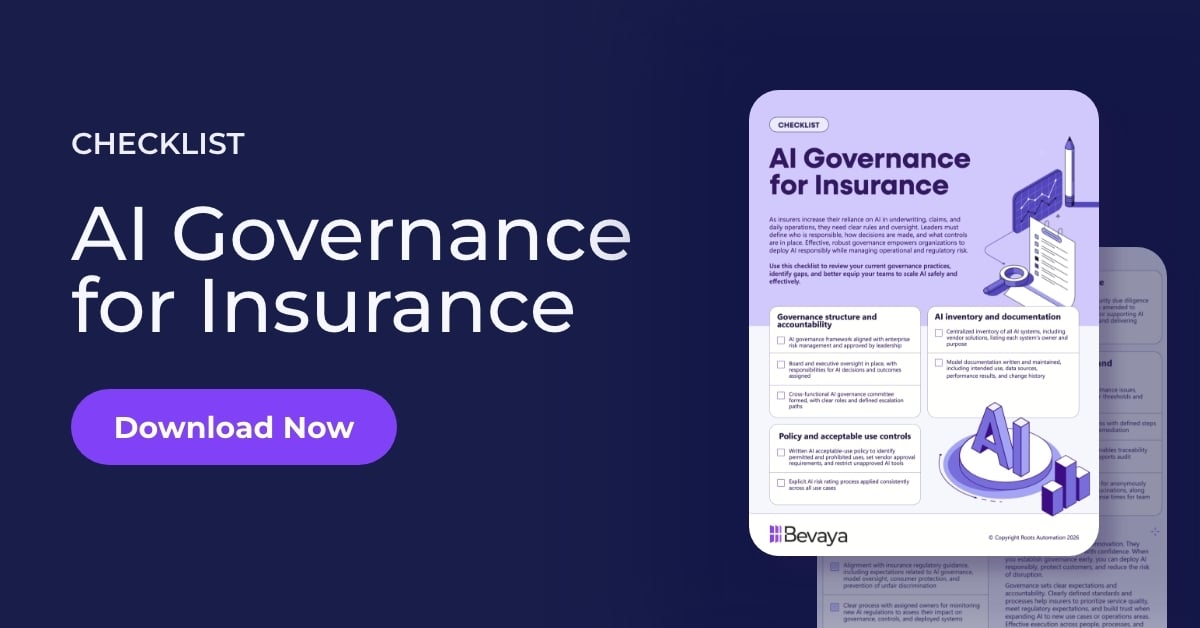
Good governance or good AI governance rather means regular check-ins for oversight. A defined process for flagging and resolving problems and shared standards for measuring performance. This is why governance is not a layer you add later. It's something you should establish early.
It's no longer just about the use case at this point. It's about how you implement it. This, by the way, is where the industry is sending a very very clear signal. Formal oversight is no longer optional.
Nearly three-quarters of insurers already have an AI governance structure in place or in the pro in the process of of implementing it. At the same time, about a quarter still have no defined plan. And that gap matters because as AI moves into production, governance becomes the difference between controlled scale and an unmanaged risk. It's what creates consistency.
It's what ensure ensures decisions are documented and defensible. And it's what allows organizations to move forward with confidence. Without it, progress slows, not because the technology isn't working, but because the organization doesn't have the structure to support it. And in a regulated industry like insurance that creates both operational and regulatory risk, this is critically important.
So again, it needs to be built early. On the next slide, we'll walk through how to put that into practice. So how do you operationalize governance? Having a committee is one thing.
Making it effective is an entirely different exercise. So focus on the structure. Bring together the right stakeholders, operations, IT, compliance, and business leaders. Not just for visibility, but for shared ownership around decisions.
Then define roles and decision rights. Who owns the use case? Who approves it? And who is accountable for the outcome?
Without that clarity, governance becomes a dis a discussion, not a decision. Next, establish a consistent cadence. You need regular reviews to evaluate priorities, performance, and risk. This keeps initiatives moving and prevents them from stalling.
Standardize how you evaluate that that success. By the way, use consistent measures for accuracy, ROI, and workflow impact. Decisions need to be based on data, not opinion. And finally, build in feedback and escalation paths.
AI will not be perfect. There will be exceptions. What matters is having a clear way to address them and feed that learning back into the process. That's what allows governance to support scale instead of slowing it down.
4. Human oversight in core AI workflows
Chaz Perera, BevayaNow, this is where the conversation starts to shift because AI is not just about automation. It's about how work is divided between AI and people. AI will take on repetitive tasks, reducing the need for the same roles and shifting other work towards higher value judgment based work. More broadly, what AI does is change where people add value.
The important shift here is not whether humans are involved. It's where human expertise expertise actually matters. AI is most effective when it's handling the preparation, triage, data extraction, summarization, and and recommendations. That's the work that is repetitive and time-consuming.
And it allows people to focus where their expertise matters most, specifically on validation on on on exception handling and making the final decision. That's the work that requires judgment. This is not about removing humans from the process. It's about placing humans in the right part of the process.
And that requires a very intentional design. That judgment role also includes oversight, building checkpoints, review checkpoints, exception thresholds, and audit trails directly into your process and being explicit about when humans are in the loop and who's accountable when something flags or or what decision actually requires a human call. Human oversight is not something you add later. It has to be built into the workflow from the start because that's what creates consistency.
That's what creates accountability and candidly that's ultimately what creates trust. So how do you actually design that into a workflow? Since we just went over that this does not happen by default. It has to be intentional.
Start with AI preparing the work extracting data summarizing information and routing tasks. That's where you get speed and consistency. Next, apply thresholds. Not everything should go straight through.
Low confidence outputs and exceptions need to be flagged. Meaning, anything that AI isn't sure about needs to be caught and reviewed. That's what determines when human involvement is actually required. Then define where human judgment is needed to validate those outputs, handle those exceptions, and make those final decisions.
That's where judgment should be applied. And just as important, that feedback is used to retrain and improve the AI over time. This is what turns oversight into a continuous learning loop. This is what effective oversight looks like.
It's not layered on top. It's built into the workflow. And that is what'll allow you to scale with consistency, control, and trust.
5. Role clarity and change management
Chaz Perera, BevayaNow, best practice five, right? Once the once AI is built into the workflow, the next challenge is really about adoption because this is where most organizations struggle. It's not technology but how that technology and the people are expected to work differently. As AI takes on more of the prep work, the structure of work begins to change.
And when that change is not clearly defined or communicated, it creates a significant degree of uncertainty. People hesitate. They second guess the outputs. They default back to their old ways of working.
Not because AI isn't working, but because their expectations are just not clear. That's why this step is critical. So define early what roles or or rather how roles will change and where human expertise still matters most. Train employees on how to actually work with the new tools, not just that they exist.
And be clear about who owns what. So people aren't second-guessing their role or the a excuse me or their role second guessing their role or the AI's adoption is not going to be about introducing AI. It's about creating clarity about how work is done going forward. Adoption does not come from the capability alone is really my point.
It comes from clarity, communication and confidence. How do you actually create clarity and consistency when people are working with AI? Well, it's it's obvious stuff but start with ro clarity. Define how work is structured going forward.
Where is AI used? Where is human judgment required? Then focus on real workflow training, not gener not generic tools. Show people how AI fits directly into their day-to-day work within their role.
Then establish clear boundaries. When should AI be used? When shouldn't it? When should things be escalated?
To whom? That removes hesitation and creates consistency. Leadership reinforcement here is also critical. By the way, managers need to consistently communicate expectations and reinforce how AI should be used in practice.
And finally, you have to monitor adoption. look at how AI is actually being used, where people are overriding it or ignoring it, and where pe and where they are struggling because that feedback is what allows you to adjust and improve how AI fits into your workflow. And again, that is what turns adoption into an operational capability or it that it's what helps AI become that true operational capability. Now, even with the right structure in place, adoption is not a one-time event.
It has to be sustained over time because as AI becomes part of the workflow, the way people interact with it starts to evolve. That's that starts with ongoing training, not just at rollout, but as workflows change and new use cases are introduced, people need to continuously build confidence in how they interpret outputs and when to step in. It also requires reinforcing the right mindset. AI should be understood as a decision support tool, not a replacement for expertise.
That perspective needs to be consistently communicated and reinforced by leadership. And just as important, it requires continued investment in integration, in governance, and in supporting how teams work with AI over time. Because without that ongoing commitment, adoption will stall and AI and AI remains a point solution instead of becoming part of the overall organization and how that organization operates.
6. Proofs of value as decision points
Chaz Perera, BevayaBecause one of the most common patterns we see is pilots that continue without clear outcomes. They they they run longer than expected. They expand scope. They stop being being decision points.
And at that point, they're no longer pilots. They're ongoing experiments. And that is slow, slow, slow progress. Because without clear end points, it becomes difficult to determine what is working and what should move forward.
That's why proofs of value need to be structured. Start by defining success upfront. What outcome are you trying to achieve and how will you measure it? Then evaluate the performance against those goals.
Use consistent metrics that that we've discussed earlier in the session. So results are clear and comparable and most importantly make a decision, move forward, refine the approach or just stop. The o the goal is to learn quickly and move forward with clarity. If it's always in pilot, it's not a pilot.
It's production without any discipline. So, how do you how do you make sure a pilot actually leads somewhere else? The goal is not just to run a pilot, it's to make a decision. A proof of value is not something separate.
It's how you measure success within the pilot. Start by narrowing the scope. A pilot should focus on one use case, one workflow, one clear problem to solve. That keeps the evaluation grounded and makes the outcomes easier to assess.
Next, define the proof of value criteria before the work begins, not after the fact, not once results start coming in. You've got to define it up front. What business outcomes are you trying to improve and what evidence will tell you whether it worked? Then establish clear boundaries around the pilot, a timeline, a clear start and end point.
Without that, a pilot starts to drift and the organization loses discipline and frankly loses interest. And finally, assign decision ownership. Someone has to be accountable for deciding whether to proceed, adjust or stop. That's what makes a pilot effective.
It's not just there to prove the technology can do something. It's there to help the organization make a decision with confidence. Every pilot and proof of value should end in a decision. Either proceed, adjust, or stop.
7. Data readiness for AI by use case
Chaz Perera, BevayaThe next barrier organizations run into is data and more specifically the belief that data needs to be perfect before you can get started. In practice, that's what slows everything down because because organizations start trying to solve enterprise data challenges before they've even proven value in a single workflow. AI doesn't require perfect data to begin. It requires enough data to support a specific use case.
That's the mindset shift you all have to have. Instead of is all of our data ready, ask do we have the data needed to support this workflow? If the answer is yes, move forward. And as that workflow scales, the data will improve.
Structure gets better. Quality improves, gaps get addressed. The goal is not perfection, it's progress. But the data you use, but but the data you do use, ensure you have standards to keep it secure and so you don't risk exposure.
Make sure the right people have access to the right information and that sensitive information is protected throughout the process. Now start with the data that already exists within your workflow. Not the entire not the entire enterprise data set just what is required to complete the task. That keeps the scope focused and allows you to move forward without delay.
Then validate that the key data points are usable. Again not perfect usable. Can the information be accessed? Can it support the workflow?
If the answer is yes, that's enough to begin. From there, improvement will happen over time. As the workflow runs, you start to identify gaps, missing fields, inconsist inconsistent formats, opportunities to standardize. Start to address those as part of the process.
This is actually what will improve your data over time. The goal is not to fix all your data. It is to enable the work to move forward. Now this is what the data approach looks like across different workflows.
The approach is consistent but the data you focus on depends on the work being done. In underwriting it starts with a sub with submission data and loss runs. The goal is to make sure the key information needed to evaluate risk is accessible and usable. Anything missing or inconsistent can be addressed as part of the review process.
In claims, it's typically it typically starts with a first notice of loss and and supporting documentation. And in policy servicing, the focus shifts to endorsements and invoice data. You're you're confirming that the data required to complete the transaction is available. As volumes increase, you're you begin to standardize and refine that data over time.
The priority is making sure intake data can be used immediately. From there, classification and structure can improve. More data flows can improve the system. Each and every workflow will improve the data that you're collecting.
But focus on the data required to support the work in the moment, not the gaps across the organization because you're not again trying to solve everything all at once.
8. Not all AI is the same
Chaz Perera, BevayaUp to this point, we focused on how to prepare the organization. But once you decide to move forward, the next question becomes more specific. What AI are you pl what AI are you planning to use? And if the route you choose is to partner with a vendor rather than build in-house, then you need to look carefully at what each vendor is actually offering.
Not all AI is the same and that becomes very clear in insurance. General purpose AI struggles with comp the complexity of insurance work. Documents are unstructured. Workflows are fragmented and regulatory requirements add a layer of constraint that brings complexity.
That's not what generic models are built for. Domain specific AI is different. It's designed around insurance workflows. It understands the structure of the data and it's built to operating within within regulatory expectations or constraints that allows it to deploy faster, requires less customization and produces outputs that are easier to validate and audit.
That's the difference that matters because even with the right workflow and data in place, the AI you choose will shape both outcomes and your ability to successfully deploy at scale over time. So, how do you choose the right AI? At this point, the focus shifts from concept to evaluation. What should you actually be looking for?
First, it needs to be built for insurance workflows, submissions processing, claim servicing, policy servicing, etc. The AI should align to how the work already happens, not require to redesign your entire process around it. Second, it has to handle complex documentation like loss runs or emails. That's the majority of the way work comes into your organization and where many solutions start to break down.
Third, it needs to support compliance. Outputs have to be transparent. It all has to be auditable. Insurance decisions need to be explainable and defensible.
And fourth, it has to work within your existing operations. It needs to integrate with your systems and your teams, not operate as something separate from how the business actually runs. These are the signals of AI that will actually work in your environment. And this is where validation becomes critical.
You confirm all of this through that pilot or proof of value. Not just whether the technology works, but will it fit into your workloads? Because that's ultimately what determines if it's the right fit and allows you to scale.
9. Continuous monitoring and feedback loops
Chaz Perera, BevayaThe final best practice is about what happens after deployment because this is where AI either delivers sustained value or starts to break down over time. AI is not something you implement once and walk away. Performance changes, data evolves, workflows shift, and over time results can drift. That's why continuous monitoring is so critical.
You need to understand how the AI is performing in production, not just at launch, but on an ongoing basis. That means tracking accuracy, exception rates, and how often human intervention actually is required by monitoring. But monitoring alone is not enough. You need those feedback loops.
Capturing how the AI is being used, where it's working well, and where it's creating friction is important. That feedback is what allows you to adjust, refine, and improve performance over time. This is what turns AI into an a true operational capability. this is what turns it into a permanent operational advantage.
and and driving capacity, improving service and reducing manual workloads over time is really why you're deploying the technology to begin with. So what does monitoring actually look like in practice? It starts with tracking performance consistently, accuracy, exception rates, and how often human intervention is required not just at a point in time, but what does that look like in an ongoing basis? This gives you visibility into how the AI is performing in real times.
But monitoring is not just about metrics. It's about identifying where performance is starting to shift, where outputs are becoming less consistent, where exceptions are increasing, or where your teams are more frequently overriding results. These are early signals that require attention. And that's where the feedback loops come in.
Capturing input from users, understanding where friction exists, and feeding that back into the system so adjustments can be made is a critical exercise in being able to retrain these models, refine thresholds, or improve the workflow design entirely. This is what keeps performance aligned over time and ensures that AI continues to operate as expected in production. Monitoring is not about tracking performance. It really is about managing it.
Recap of the 9 AI best practices
Chaz Perera, BevayaSo here's a handy list of all the nine best practices that we just walked through. As we step back and look across all of them, a few patterns do become clear. This is not about adopting AI as a tool. It's about building it into how your organization operates on a day-in, day-out basis.
The organizations the organizations making progress are not approaching this as a series of experiments. They are applying structure, clear ownership and accountability, alignment of measurable business outcomes and governance that supports both implementation as well as scaling. They are design they design workflows where humans humans and AI work together to make those great judgment calls reducing manual work and placing people where that judgment and expertise really matters. They are they're also disciplined in how they execute.
They're using pilots or proofs of value as decision points, not as experiments. They're making clear calls to proceed, adjust, or stop. And just as important, they're taking a practical approach to data and technology, starting with what they have, focusing on what the workflow needs, and selecting AI that fits the complexity of insurance. And finally, they recognize that this does not end at deployment.
AI has to be actively managed in production, monitored, refined, and continuously improve improved over time. When these elements come together, AI becomes becomes how you operate, not just how you innovate.
The takeaway: execution, not possibility
Chaz Perera, BevayaSo as we close, the takeaway is simple. AI is no longer a question of possibility. It's a question of execution. The technology is here.
The use cases are very clear. What separates organizations now is how they implement it and how they operationalize it. And depending on where your organization is today, some of these best practices will matter more than others, but the pattern is consistent. The organizations making progress are not trying to do everything at once.
They're starting with a they're starting with defined workflows and applying structure and making disciplined decisions on what to move forward with. Essentially, they're building the foundation first because that's what allows you to to to use AI with confidence. And that what's is what ultimately allows you to to scale. With that, I'll turn it back to you, Jill.
Jill Zakarian, BevayaThank you, Chaz. That was a lot to cover, but hopefully everyone's walking away with a clearer sense of the foundation it takes for AI programs to scale and have some great ideas to bring back to your teams. And before we dive into our Q&A, I'd like to invite you to explore the many other sessions available on demand.
Q&A: Where to start if you feel behind
Jill Zakarian, BevayaOkay, Chaz, it looks like we have a a few questions coming in. Okay, give me a moment as I pull up our Q&A queue. Okay. first question that I'm seeing, Chaz, we we are still in early exploration mode and feel like we are behind.
Where do you recommend we start when it comes to building our AI foundation?
Chaz Perera, BevayaGotcha. so I I suppose one of the first decisions you will face an exploration is whether to build or buy. For some organizations, building internally means it it seems appealing at first, right? however, the reality with that route is that what looks straightforward in exploration often reveals its full complexity in testing and production.
ongoing model tuning, infrastructure monitoring, compliance, operational support all introduce cost and complexity that were not really visible up front. That is when many organizations reassess and realize that partnering is the faster lower risk path. and and partnering with the right vendor accelerates your foundation significantly anyway. A vendor that specializes in insurance already understands your documents, your workflows, and the regulatory environment.
So you're more than likely to get to to production a lot faster with proven accuracy, proven benchmarks and a team that's solved that problem a few times if not many many many times over and over again.
Q&A: Proving AI ROI to leadership
Jill Zakarian, BevayaGreat. the next question I am seeing Chaz our leadership team is supportive of AI but keeps asking us to prove ROI before they will commit budget. how do other organizations handle that?
Chaz Perera, Bevayawell you're not alone. 40% of insurers in our "State of AI Adoption in Insurance" report cited unclear ROI as the top barrier. The key to define your success metrics before you is to is to do all of this before you start, not not after the fact. That way you can ground your business in your current process performance.
How long does it take to do something today? How quickly do you need to respond back to your customer? How many people does it require? How often you know are errors made in that process that leads to rework?
Those baselines become your benchmark. then you can connect that to your AI initiative directly you know to a specific set of KPIs that will help you focus on cycle time reduction or throughput improvement or expense control. So you know starting with high volume manual tasks or workflows also helps because those are frankly the easiest to generate savings from. but they also will give you early wins that will build a business case for something that's a much broader investment.
Q&A: AI governance for a midsize carrier
Jill Zakarian, BevayaOkay, next question we have in we have heard a lot about AI governance but we are a midsize carrier and do not have the resources for a large committee. Is formal governance really necessary at our stage?
Chaz Perera, BevayaI suppose the short answer is yes, but it doesn't have to be complex to be effective. governance isn't meant to suggest bureaucracy. By the way, it it is meant to focus on clear ownership around AI decisions, defining checkpoints that where you can review performance and and frankly just ensuring that individuals within the evaluation process or post-production understand their accountability. without that you know your AI usage may grow but you may not understand the the underlying value that you're trying to generate or the operational and regulatory risks might become harder to manage.
So think of governance as part of the foundation of the work not something you add after the fact but you don't need to do everything we outline there pick the things that make the most sense for you.
Q&A: Getting frontline teams on board with AI
Jill Zakarian, BevayaOkay, our next question how do you or how do we get our frontline claims and underwriting teams on board with AI? we are seeing some resistance at the operational level.
Chaz Perera, BevayaYou know this comes up frequently. people some people still have a a tendency to think, you know, AI is bad because it might be looked at as something that's coming after their job. Here here are a few things that tend to work work well. First, be clear about what AI is and how they can benefit from it.
In most cases, it would handle the prep work, the routing work, the summarization work that humans tend not to want to do, but it allows humans to retain authority over the final decision, which is where humans really want to play. When people understand that AI is there to reduce their personal administrative burden, not necessarily replace their judgment, the resistance tends to lower. The second thing I'd say is involve operational teams early in the process at the pilot stage or the proof of value stage, pre-production in testing, those types of things. they know the work better than anyone anyway.
they do it every day and their input on where friction is, what good outputs look like, where exceptions are likely to live and that that starts to become invaluable to you as you're implementing implementing AI. and frankly will make your implementation significantly stronger. and then the last thing I'd say all of this is about change management and change management starts at the very beginning, right? how you communicate, what you communicate, why you communicate, and how you train your teams and how you choose to support them through the transition will directly impact adoption and long-term success.
and believe it or not, everyone talks to each other. So if you create a great experience in one pocket, it'll be communicated to other parts of the organization and that resistance will come down over time.
Q&A: Moving an AI pilot into production
Jill Zakarian, BevayaGreat. we have another question. we have a pilot running right now that is showing promising results. What should we be thinking about before we move to full production?
Chaz Perera, BevayaAll right. Well, first first off, congrats to you. that's exciting. a few things to think through before you scale.
what KPIs are you are you measuring? Are they clearly defined? Are they trackable? Those are things you want to know before you go live.
in in my opinion, the obvious ones here are cycle time, volume throughput, exception rates, and and cost per transaction. it's going to be the things that matter most to your business. and and the underlying business case that you developed. it also helps you sort of establish those baselines and and create the right measurement mechanism so that you can demonstrate value in production from day one.
last last thing I'd say there too is think about accuracy of your baseline. you will going back to the prior question around trust. having a benchmark that people believe about where you are today matters just as much as the bench the the the the values or the metrics that come out of leveraging AI because if those two things are disconnected if they don't trust where you started as part of the change management process you will struggle to get them to trust where you're trying to go.
Jill Zakarian, BevayaAll right, we're going to stop there. I know there was a lot to discuss today. We appreciate you making time to log on and join us today. For any questions we didn't have time to cover, we'll reach out to you after the session.
As a reminder, we'll share a recording of today's session by tomorrow afternoon. And we hope to see you at future sessions. And have a great rest of your day.
Frequently asked questions
What are the best practices for implementing AI in insurance?
Chaz Perera's nine best practices are clear ownership and executive accountability, aligning AI to measurable business outcomes, cross-functional governance, human oversight in core workflows, role clarity and change management, structured proofs of value, use-case-driven data readiness, choosing AI built for insurance, and continuous monitoring with feedback loops. Together they give insurers the structure to move AI from pilots into production and scale it.
Where should an insurer start with AI?
Start with high-volume, manual workflows such as submission intake in underwriting, FNOL intake and document indexing in claims, and endorsements and certificate of insurance issuance in policy servicing. These processes are repetitive and easy to measure, so teams can validate results, build trust, and then expand to more complex use cases.
Does a midsize insurer need formal AI governance?
Yes, and it can stay simple and still be effective. Chaz Perera recommends clear ownership of AI decisions, defined checkpoints to review performance, and clear accountability for everyone involved in evaluation and production. Pick the elements that make the most sense for your organization.
Does AI in insurance need perfect data to get started?
AI needs enough data to support one specific use case, and perfect data is not a prerequisite. Start with the data that already exists in the workflow, confirm the key data points are usable, and improve data quality as the workflow runs.
Related resources
Get new sessions first
New webinars, customer stories, and product videos from Bevaya.
- New webinars and interviews as soon as they go live
- Customer stories from insurers putting AI Agents into production
- Product walkthroughs of new Bevaya capabilities

