


Customer Story
How Insurers Get AI Into Production
Erie Insurance, Guidewire, and Bevaya on moving AI past the pilot and into everyday claims work.
About this conversation
Erie Insurance got AI out of the pilot and into production. This conversation shows how.
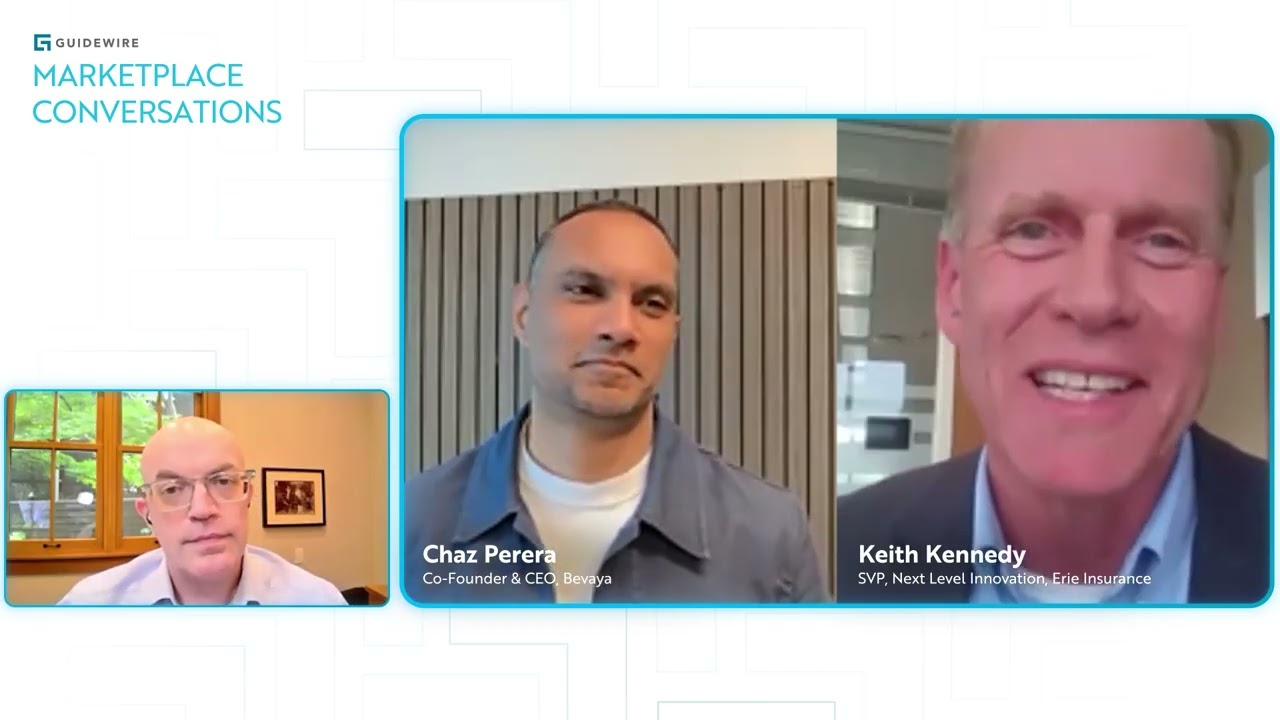
In Guidewire's Marketplace Conversations series, Guidewire CMO Brian Desmond sits down with Keith Kennedy, who leads innovation at Erie Insurance, and our Co-Founder and CEO, Chaz Perera. Erie starts every AI effort with a real business problem, runs it through its AI Center of Excellence, and wires every experiment into agile delivery so the winners ship.
The proof is in claims. Erie and Bevaya run claims document ingestion connected to Guidewire, starting with a couple of mail centers and expanding to every mail center and email. Work that took a day or two now happens in a minute or two, and adjusters spend that time with claimants.
Why it matters. The ROI case for AI is won or lost after the pilot. Erie's playbook shows how to win it: intentional experiments, phased rollouts, and change management from day one.

Keith KennedySVP Next Level Innovation, Erie Insurance
Keith leads innovation at Erie Insurance, spanning core business innovation, new business ventures, and Erie's venture capital program.
What you'll learn
Skip the innovation theater
Erie ties every AI experiment to a real business problem and to its agile delivery process.
Three principles for build, buy, or partner
Use the right tool for the job, build only for differentiation, and drive fast under control.
A day or two becomes a minute or two
Claims documents reach the right people faster and more accurately, freeing adjusters for claimants.
Bring enterprise risk in early
Models drift, so risk teams need a view of day one, day 30, and day 60.
Full transcript
Introductions
Brian Desmond, GuidewireHi everyone, my name is Brian Desmond, CMO at Guidewire and I'm very excited to engage in a conversation with a Guidewire customer and a partner on a topic that's near and dear to our hearts, innovating with AI in insurance. I'd like to now pass the mic over to our guests Keith Kennedy (Erie Insurance) and Chaz Perera (Bevaya). Gentlemen, would you like to introduce yourselves, please? To start with you, Keith.
Keith Kennedy, Erie InsuranceVery good. Thank you, Brian. I'm Keith Kennedy. I lead innovation at Erie Insurance.
And for every insurance company, that means something a little bit different. For us, innovation means helping the core business be more effective innovators. Secondly, exploring and standing up new businesses to create new sources of revenue for the company. And third, I'm responsible for our venture capital program where we build mutually beneficial partnerships with startup companies to accelerate innovation at Erie.
Brian Desmond, GuidewireThat's phenomenal. Chaz?
Chaz Perera, BevayaThanks, Brian. Thanks, Keith. I'm Chaz. I'm the co-founder and CEO of Bevaya.
We've built a platform of pre-trained AI agents for insurance. You drop them into claims, underwriting and policy servicing workflows and they handle the work that buries insurance teams and humans stay in the loop on the exceptions.
Moving beyond AI experimentation
Brian Desmond, GuidewireOne of the things that's really impressed me about Erie is that Erie is now reaching a stage where you're really driving sustained value with AI and moving beyond the experimentation phase and Keith, it sounds to me like you've got a pretty unique role, you and your team. So, what has been the approach that characterizes what Erie is doing?
Keith Kennedy, Erie InsuranceYeah. Brian, let me start by saying I am not a fan of "innovation theater," which we hear a lot about in the industry. I am a huge fan of using innovation to create differentiated impact, business impact. And so, the way that we approach that in innovation here is we use a design-led approach to problem solving.
We fall in love with the problem. We co-create concepts that we go out and rapidly test in the real world to see what we can learn and iterate to determine if we can align a problem with a differentiated solution. But it's a very intentional process and similarly in the AI world as we established our AI Center of Excellence a few years ago here we took a similar approach. In fact, the purpose of our AI Center of Excellence was to accelerate learning, adoption and positive business impact of AI while effectively managing the risk.
Okay. So again, very intentional, never about just go see what happens, but a very intentional approach. And then the other thing that we've done that has worked well for us is wherever the experimentations occur it they need to connect with the way things get delivered and for us we use an agile delivery methodology like most large companies and by connecting the experimentation work as a form of discovery in the agile process allows us to create an intentional path to delivery for those learnings that bear fruit.
What insurers driving AI value do differently
Brian Desmond, GuidewireChaz, you're also in a position to kind of observe what insurers are doing in the industry and obviously your customer base. What's impressed you the most with respect to insurers that are driving sustained value?
Chaz Perera, BevayaYou know, I think Keith started describing his role with a focus on a real problem. And historically when AI has been part of the modus operandi of an insurance company they're typically finding really esoteric things to apply the AI to and in the four walls of a pilot, Brian, it makes sense, but at scale it doesn't because the problem isn't big enough or the or the severity around solving the problem for the company doesn't really move the needle in the way that they would expect it to. So what's really changed and the and the companies that are successful have found the right use cases with the right sizing to actually apply AI to make a difference.
Brian Desmond, GuidewireYeah, I would totally agree from our perspective. The things that impress us the most are the insurers who kind of take a look out like five years and say that the world is going to look utterly different in insurance. If we all believe in that future strategically, let's get going now on driving so it becomes a real strategic driver throughout the entire company.
Build, buy, or partner: Erie's three principles
Let's go back to you Keith. You've got a I think a very unique role. So you're there's an investment part of your remit and an operator part. So how do you go about kind of the decision around, hey, you know, do we build it ourselves, do we invest, do we partner?
How does that decision come about?
Keith Kennedy, Erie InsuranceYeah, for us there's really three principles that I think have served us really well. First, we start with use the right solution for the job or the right tool. Okay, that's non-negotiable. Second, we build for differentiation, and we're careful to know the difference between something that's truly differentiated and something that might be approaching more commodity status, right?
And third, we have a principle of drive fast under control. So I think those principles will continue to serve us well as we move forward.
AI claims document ingestion with Guidewire
Brian Desmond, GuidewireLet's shift gears a bit and come to something that is really more specific that's underway at Erie and this is the work you're doing on the claim side with Guidewire and with Bevaya. Keith, let's start with you if you could explain kind of the this the scope and scale of what you're doing and after that talk about some of the benefits that you're seeing on the claim side.
Keith Kennedy, Erie InsuranceSure. So let me start with you know the obvious. Any insurance company's claims process includes lots of documents, right? Coming in different forms from a lot of different channels or directions.
Efficiently executing the process and allowing ourselves to delight claimants and customers requires that we get the right documents to the right people as efficiently and as effectively as possible. Historically, this has required rules-based automation and a lot of manual effort. What we've been doing with Bevaya now is in what I would describe Chaz to be intelligent automation. And we were able to quickly implement a claims document ingestion solution with Bevaya connecting to Guidewire, of course, for us on the claim side and we started in the physical mail space with just a couple of mail centers and then we've expanded to all mail centers and email.
And the reason we did it that way is because we take very seriously the kind of the human change element of all of this and we wanted to make sure that we were very thoughtful about the change management albeit we could have turned it all on day one. We thought for our people and for our customers it was better to step into it a little bit.
Claims results and the adjuster experience
Brian Desmond, GuidewireAnd is it now at scale or is that is that okay? What business benefits have you have you seen to date?
Keith Kennedy, Erie InsuranceI if I could, Chaz, I'm going to ask you because you're more current on the specific numbers and progress. But if I could ask you maybe to cover that one.
Chaz Perera, BevayaYeah. Happy to, Keith. And Brian, you know, when we look at how this type of work is done poorly, it means you're not responsive to your policyholder. You're not responsive to your to your to the claimant.
And what this has meant for Erie and others frankly is what might have taken a day or two now happens in a minute or two. And what required many people, not just people in service centers, but typically the claims adjusters to engage with and conduct, right? Emails come to them, they have to do something with it. Snail mail goes into a service center, gets scanned, somebody has to do something with it.
All of that no human at Erie is getting joy from doing. No human at any insurance company is getting joy from doing. So it's an opportunity to take that work off their plate, do it faster, do it more accurately. And typically what we're seeing, you know, this is true for Erie, this is true for many of our customers.
You know what a human only does at 80% accuracy suddenly technology is doing at 95, 96, 97% accuracy, but also doing it faster, fundamentally changes the opportunity for the adjuster, which is, I don't have to do this work I got no joy from. I can focus that time with the policyholder, with the claimant, trying to resolve their issues, trying to give them joy.
Brian Desmond, GuidewireYeah, I totally agree. So congratulations on what you've achieved so far Keith with you and team.
Change management for AI adoption
You mentioned the critical importance of change management. I'm curious as you went through this on the claim side, did you redesign some of the rules that were in place? And if so, what were some of the specifics on that and what were some of the lessons learned?
Keith Kennedy, Erie InsuranceYeah. So, let me start Brian by just telling you how we approached that in a little bit more detail. I'd start by saying we do it very thoughtfully. Okay.
And we've always been a company that has emphasized skill development and encouraged people to broaden their skills and grow their career and work in many parts of the business and so forth. And I believe this concept of workforce flexibility serves us well in the AI era as well. And so the way we've approached it is specific to AI is start with tasks that people would prefer maybe to be to be done a different way, right? More manual, more redundant.
And by automating those things, it creates opportunities for more people to go on and do something else, which is consistent with our culture anyway, right? So that's good. The second thing that we've been doing and found to be successful is just encouraging more people to try new things. And when it comes to change management, one of the It becomes easy when people were part of the solution.
It's a lot harder when the solution is imposed on people or it feels like it's imposed on them. And so just making people part of the solution and just becoming more familiar with that, you know, pace of change and so forth is powerful. And then finally, there is a continuous education effort that's required here. Because the world isn't standing still and it's hard for any one person to know exactly what's going on at any moment across such a wide range.
And so just continuous education and storytelling about what we're doing and the positive impact that it's having. And it's helpful when you can share the positive impact being both to the business and to the people doing the work.
Why enterprise risk belongs in AI change management
Chaz Perera, BevayaBrian, if I could add, you know, when you think about when you, you know, I think this is sort of like helpful perspective for Guidewire's customers, which is in the in the world of AI, that change management exercise is not just about the people impacted by the software, but pre-implementation of any of the software. You should you really should think about all the other parties at your company that might have input into how the software works. For example, enterprise risk is a critical factor in this because models aren't a static exercise, right? They drift.
And so giving people on the enterprise risk side perspective on what things will look like day one versus day 30 versus day 60 and the ways to mitigate the risk that might come with a model starting to decide differently about an answer, right? Or remove some of the predict or predictability that change management exercise is much broader than people have historically thought about it because we typically think about change management as the people directly impacted by the change but there's so much more in the in the context of AI that you really have to think about.
How to make insurer and vendor partnerships work
Brian Desmond, GuidewireYeah, it's a great point and you're in this place where you're clearly leading innovation in collaboration with partners like Guidewire and Bevaya. Sure. What advice would you give to insurers that want to do the same kind of go down the same path as you with respect to how to how to work with partners?
Keith Kennedy, Erie InsuranceYeah, I think the four things come to mind for me that are critical to making partnerships work. The first one is really about me or us the insurer. We need to welcome the help and sometimes that can be a little bit difficult. So if we have that one in place then we go on to the next one and I think the next one is the parties whoever they are need to have a shared definition of success and shared incentives.
Next one would be I think we have to share some type of common beliefs and I'll share an example of that with you. At Erie the only way we sell anything is through independent agents. If we're trying to solve a problem and the partners that we're working with think that agents aren't valuable, that's probably not going to be a partnership that's going to do really well, right? And so I think there's a degree of shared beliefs that's critical.
And if you get that right, you can get anything done. And if you get that wrong, everything's hard. Okay. Yeah.
And then finally, I think what needs to be in place in order for the partnerships to thrive is you actually need to be able to execute well together. You can get all that other stuff right. And if you don't execute well, the value doesn't occur and then nobody wins.
Brian Desmond, GuidewireChaz, is there anything you'd like to add to that list from your point of view?
Why AI ROI dies after the pilot
Chaz Perera, BevayaYeah, I think Keith's last point I break it into a few other sort of categories below it that the time to value collapse is very real. And you know it typically materializes because you know the vendor and the and the and the customer did a proof of concept but that proof of concept was in a very sterile environment. It doesn't properly reflect what happens in the real world. And so suddenly you both realize, oh gosh, this is way harder than we thought it was or it's going to be noisier or messier than we thought it was.
It's not uncommon for internal IT at a customer to be a, you know, to be a bottleneck because they have a lot of priorities, right? A lot of things that they have to think about to help the business run. And where do where do these things fit in? I think Keith's point about you got to get everybody at the table.
So you got to make sure everyone's bought in. Is really important. And then you got to find a way to not allow the not allow it to be an option for a business user if that makes sense because it is innate in all of us to just do it the way we've done it for a long time because it's what we inherently know and are comfortable with. But to me, it's these three things that like end up where you're like the ROI thesis just quietly dies.
And I would say like those are the things you really have to think about.
Advice for scaling AI from pilot to production
Brian Desmond, GuidewireI go back to what you were saying the importance of enrolling people not just like telling people what to do because I say so doesn't work with teenagers, doesn't work with employees, you know, it's like enrolling, you know what I mean? Like enrolling people and the change making them part of it is so critically important. Most of all now I'd say so. On the final question, I'll come back to this concept of sustaining value, right?
So going from pilot to more at scale and then making these improvements systematic. What advice, you know, with the benefit of your experience, Keith, would you give to your peers in the industry?
Keith Kennedy, Erie InsuranceI would start with start with the end in mind. Okay. And work your way backwards from that. That falls into that design-led approach that I was describing earlier.
The second thing that I would recommend would be intentional about the experimentation. I think it's general curiosity I think is fantastic. I think we're in the business of delivering value and impact to our constituents and I think we need to when we go into some experimentation or learning opportunity see a path to delivering value if what we learn suggests that is the right thing to do at this time and that's the right way to do it. And then finally, I think it's really important to align the learning and experimentation efforts with the change management approach and not leave figuring out the human side of this to once we're already committed and the solutions built.
Right? I think building the change and the bringing people along from the beginning is a timeless and effective approach.
Measuring AI value beyond dollars
Brian Desmond, GuidewireChaz, anything you'd like to add to that?
Chaz Perera, BevayaYeah, I think from my perspective as somebody who's had you know the privilege to be able to work with Keith and the Erie team, I you know it's really important not just to measure the value you're creating from a dollars and cents perspective. That really matters to the CFO and to the economic buyer. But the people at the ground level who are interacting with your software, how do they see the software impacting their day-to-day? How do they feel about the outcomes that they're getting?
Are really important you know early indicators of sustained success. And so like it's really important to think about how you're measuring people's sentiment at the ground level because that I think is a really important indicator of sustain quality and completeness.
Closing
Brian Desmond, GuidewireIn closing you we could talk for a long time but we're going to stop there for today in a way and Keith most importantly I'd like to thank you for your time and congratulate you and your team. It's a fantastic story that is underway and it sounds to me like you're going to have many use cases of this at Erie. So congratulations and thank you for sharing your story with us and Chaz, thanks for joining and for your partnership.
Keith Kennedy, Erie InsuranceYou're very welcome. Thank you both.
Chaz Perera, BevayaAppreciate it.
Frequently asked questions
How does Erie Insurance move AI from pilot to production?
Erie starts with a real business problem, runs AI work through its AI Center of Excellence, and connects every experiment to its agile delivery process, so learnings that prove out have a clear route to production.
What does Erie Insurance use Bevaya for?
Erie uses Bevaya AI Agents for claims document ingestion, connected to Guidewire, to get incoming claims documents to the right people faster. The rollout started with a couple of mail centers and expanded to all mail centers and email.
Why does AI ROI often stall after the pilot?
Chaz Perera points to three causes: proofs of concept run in clean test environments that miss real-world complexity, internal IT teams are stretched across many priorities, and business users are allowed to fall back on the old way of working.
Related resources
Get new sessions first
New webinars, customer stories, and product videos from Bevaya.

