


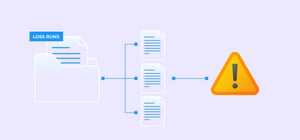
Underwriters at carriers and MGAs lose up to 40% of their time to manual submission work, and loss runs are one of the biggest offenders. Reading multi-year loss histories by hand means reconciling formats, re-keying claim counts, and calculating total incurred manually since every carrier, TPA, and broker labels and structures this data differently. Using AI automation for loss runs removes that manual layer. It reads, standardizes, and consolidates claims history the moment it arrives.
This is a different kind of automation than basic text extraction. Pulling numbers off a page doesn't require understanding what those numbers mean. Applying insurance math, mapping carrier-specific terminology to the right field, and knowing what counts as an anomaly does. That's the difference between reading data and understanding it.
This shift changes where underwriters spend their time. They start from a completed loss history and move straight to the judgment calls, assessing large claims, weighing frequency and severity trends, and deciding how a risk should be priced.
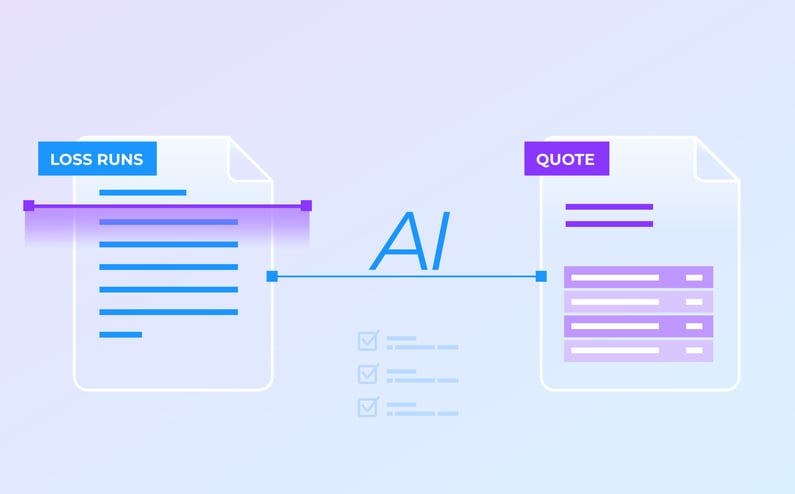
7 Steps AI Takes to Process a Loss Run
AI automation follows a consistent sequence to turn a stack of inconsistent loss runs into one usable loss history. Here's what happens, step by step:
1. Identifies and reads the loss run. The AI locates the loss run inside a submission package. It reads whatever format it's in, whether that's a carrier PDF, Excel export, scanned image, or fax.
2. Extracts the claim-level detail. It pulls the individual fields for every claim. This includes paid amounts, reserves, expenses, claim status, dates, and cause of loss.
3. Applies the insurance math. It rolls up total incurred, the paid amount plus reserves combined, when the two are listed separately. It calculates frequency and severity by policy period and coverage line. It also knows whether ALAE belongs inside total incurred or sits outside it, since that varies by carrier.
4. Reconciles across carriers and policy periods. When a submission includes loss runs from multiple prior carriers, the AI normalizes terminology, aligns valuation dates, and merges everything into one continuous loss history instead of several disconnected reports. A field labeled "case reserves" on one carrier's report, "indemnity reserves" on another, and "indemnity case" on a third all map to the same underlying value, so the underwriter sees one consistent picture instead of three different vocabularies.
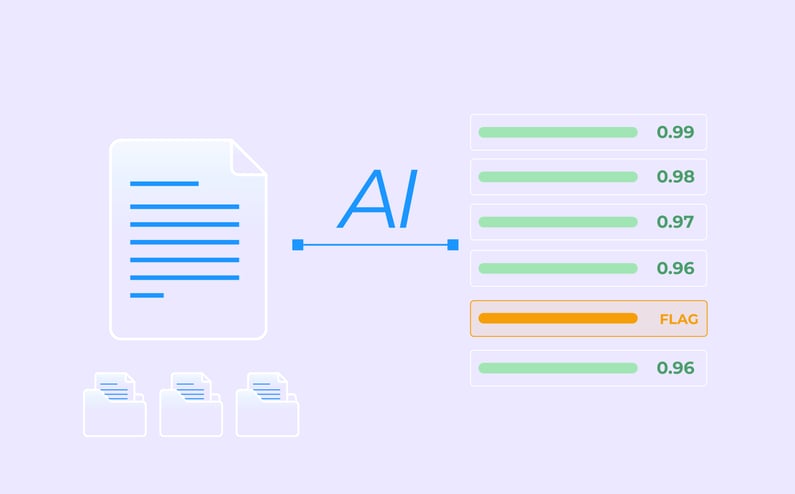
5. Surfaces what changes the price. As it aligns policy periods across carriers, the AI flags any gap or overlap in coverage dates, along with large open claims and unusual claim development, so nothing gets missed on a quick read. A reserve that jumps significantly between valuation dates, for instance, gets flagged as a signal worth a second look, instead of sitting buried in a column of numbers.
6. Delivers a quote-ready output. The finished loss history lands inside the underwriting workbench, structured and ready to price. Anything low-confidence routes to a reviewer with the source document linked, so nothing moves forward without a clear paper trail.
7. Augments with third-party data where it strengthens the assessment. Where useful, the AI pulls in relevant third-party data to support the risk read, adding context beyond what the loss run itself provides.
Each step builds on the last, so what reaches the underwriter is a loss history that has already been read, calculated, checked, and enriched. It's not raw data still waiting on judgment.
The Benefits of AI Automation for Loss Runs
Faster loss run review shortens the path to quote, which matters when bind rates depend on turnaround. But time isn't the only thing this changes.
Accuracy matters just as much. A missed large open claim or a misread reserve figure doesn't show up as a problem at quote time. It shows up later in the loss ratio, once the risk is already on the book. Catching those details before pricing protects against exactly the kind of leakage that erodes a book's performance over time.
Capacity is the third factor. Every hour an underwriter isn't spending on manual reconciliation is an hour available for the work that actually needs their judgment. That work includes weighing a broker relationship against a borderline risk, deciding how much latitude a long-standing account deserves, and making portfolio-level calls about where the book should grow. Those are the decisions that separate strong underwriting from simply fast underwriting, and they're the ones a machine can't make.
Speed, accuracy, and capacity work together here, so underwriters get a loss history they can trust the first time they see it, instead of one they have to double-check first.
Loss run processing has always been foundational to underwriting, and underwriters have always read it by hand. AI automation changes that without changing the underwriter's core job, pricing risk correctly. The technology handles the extraction, the math, and the reconciliation. The underwriter still decides.
