


Claims teams are absorbing more complexity with fewer senior people. High deductibles screen out the simple files, litigation pressure keeps rising, and what remains takes judgment that takes years to build. In front of that judgment sits the document work: sorting what arrives, setting up a new loss, spotting a demand letter before its deadline, checking a claim against the policy, coding a medical bill.
AI is the obvious answer to that work, and most claims leaders are still working out which AI to trust with it. Bevaya's recent benchmark test puts a number on that question by pitting an insurance-trained model against 12 leading general-purpose AI models, with the widest gap landing on the fields that tie a document to the right claim. The answer turns on what the underlying AI model was trained on, a distinction that rarely makes it into a vendor pitch.
What Does AI Do with Claims Documents?
Documents come in from email, mailrooms, broker portals, and partner uploads. There are dozens of types in a single bundle, none of it sorted. Someone has to work out what each page is, which claim it belongs to, and who should see it. Then comes the work each document triggers, and that work is different every time.
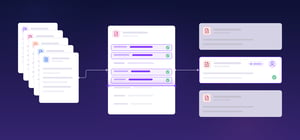
Bevaya’s claims AI Agents do that reading. They work through every page, identify the document type across more than 60 used in insurance, separate bundled documents into the right files, and tie each one back to the right claim. From there they handle what the document actually asks for: a new loss set up from an FNOL, a demand letter flagged with its response deadline, a claim compared against the policy in force, a medical bill coded and validated. They recommend what should happen next. Your adjusters keep every claims decision.
Doing any of that well takes more than reading the words on the page. A demand letter starts a response clock that a medical bill does not. A reserve has to move when new information arrives. And two similar files should be handled the same way by different adjusters months apart, because reserve variance across a team is a forecasting problem before it is a quality one.
Why Do General-Purpose AI Models Struggle with Insurance Documents?
Take a claim number. It follows no pattern, and it sits somewhere different on every carrier's form. Take reserves. Case reserves, indemnity reserves, and indemnity case can all mean the same thing depending on who wrote the document. None of that is written down anywhere public. It lives inside private insurance documents, so an AI model has either been trained on them or it's guessing from the layout of the page.
Bevaya's benchmark test showed what that difference is worth. Across 346 real insurance documents, all scored the same way, Bevaya's model came out ahead of all 12 general-purpose models on every measure. The widest gap fell on the claim-tying fields, the claim number, policy number, claimant, and date of loss that connect a document to the right file. Bevaya's model read them correctly 86.6% of the time. The strongest general-purpose model managed 72.8%. Every result is published, model by model and field by field.
A wrong claim number is the error nobody catches. Every other value on the page is right, so nothing downstream flags the file, and the mistake settles into the claim system, into reporting and eventually into reserves. It's also invisible in a headline accuracy figure because one wrong value out of a hundred barely moves a percentage while putting the whole record in the wrong place. So the number to ask any vendor about is not overall accuracy. It's how well the model reads the fields that decide where a document belongs.
How Should AI Be Governed on a Claim File?
Training decides how well a model reads. Governance decides what happens next, and in claims that matters as much, because every value that reaches the claim system feeds a reserve, a coverage position, or a report someone may one day have to defend.
That sets three requirements. The AI never guesses. A value it's not confident about goes to a person, not into the system. Its confidence has to be earned against more than one source, because a score on a single read is only how sure the model feels. And every value needs a trail, from the page it came from to the person who approved it.
A general-purpose model on its own offers none of that. It reads a page and returns an answer.
Bevaya's AI Agents are built to those requirements. Values are checked against the other documents in the packet and the claim record already in Guidewire, Salesforce, or Duck Creek. Anything below the threshold your team sets goes to your own adjuster, with Highlight Mode showing where on the page it came from, and every action is recorded. Uncertain data never reaches your system unchecked.
The Case for Insurance-Trained AI in Claims
Making this argument inside a carrier usually means answering three objections, and the evidence for each is now public.
- “We could build this on a general model ourselves.”
You could, and the benchmark shows what you would be building on. Every general-purpose model tested landed within eight points of every other, from the most expensive to the cheapest, and the gap to the insurance-trained AI model was widest on the fields that link a document to its claim. Workflow and integrations sit on top of an AI model; they do not change what it can read. - “The next model release will close the gap.”
Across the AI model families in the test, a newer generation moved field accuracy by a point or two over the one it replaced. The gap is training data, not scale, and a new release does not change what the AI model learned from. - “What does this actually do for the department?”
Files that arrive ready to work rather than ready to sort. Reserve and coverage decisions made on data checked the same way on every file. Senior adjusters spending their judgment on the files that need it rather than on intake.
Every result behind this article is published at bevaya.ai/benchmarks.
Claims leaders have already committed to AI for document work. The choice that remains is about the model underneath, and it's easy to get wrong because the costly errors don't announce themselves. A misread claim number looks like a clean file until it surfaces in a reserve or a report months later.
Training on real insurance data narrows how often that happens, and governance catches what training misses. Together they determine whether AI lightens the load on a claims team or quietly adds to it.
