



Product
Do You Have to Replace Your Core System for AI?
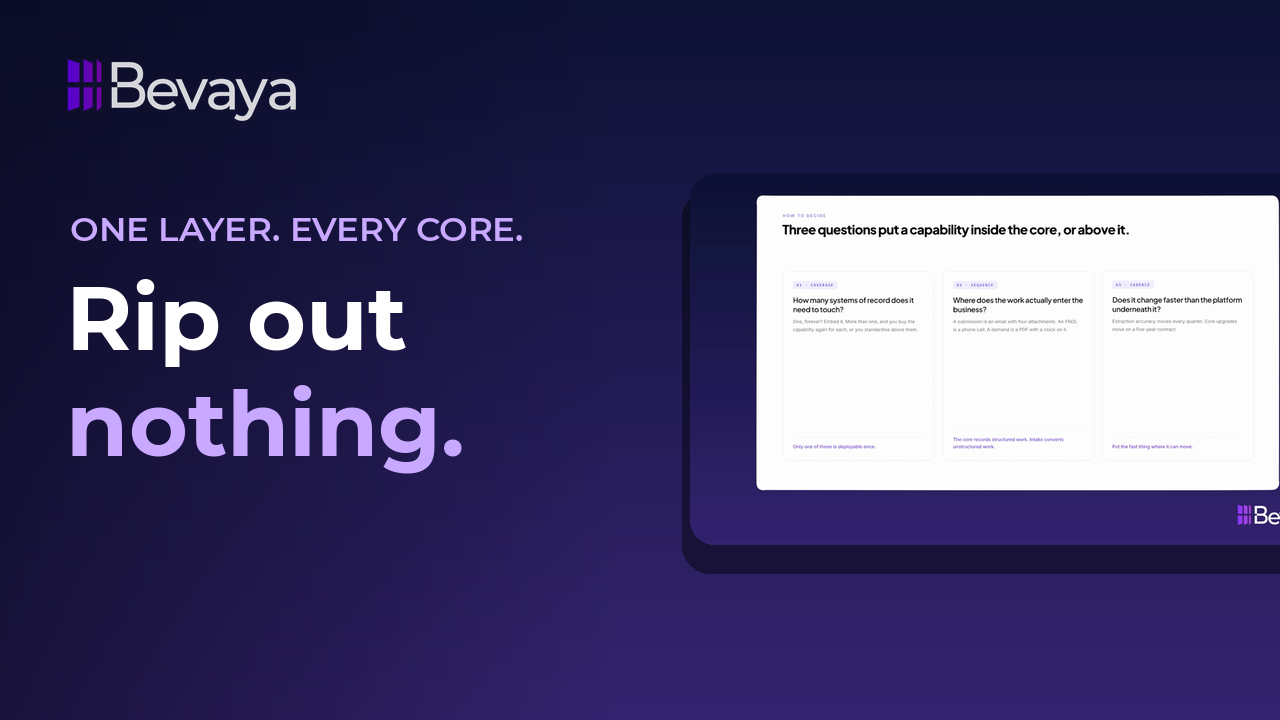
Every CIO opens with the same question: what do I have to rip out? With Bevaya, nothing. Two minutes on the three questions that decide whether a capability belongs inside the core or above it.
Video not playing? Switch video player.
About this video
Every CIO opens with the same question: what do I have to rip out? The answer with Bevaya is nothing, and this video explains why that's the wrong question anyway. Insurance estates get built through migrations and acquisitions, platform by platform, with systems inherited and rarely retired, so the real question is where AI belongs in that estate.
Three questions decide whether a capability belongs inside the core or above it. How many systems does the process touch? If it's one, embed the AI; if it's more than one, let the AI sit on top. Where does the work actually enter the business? Most work begins outside core systems: a submission is an email, a first notice of loss is a phone call.
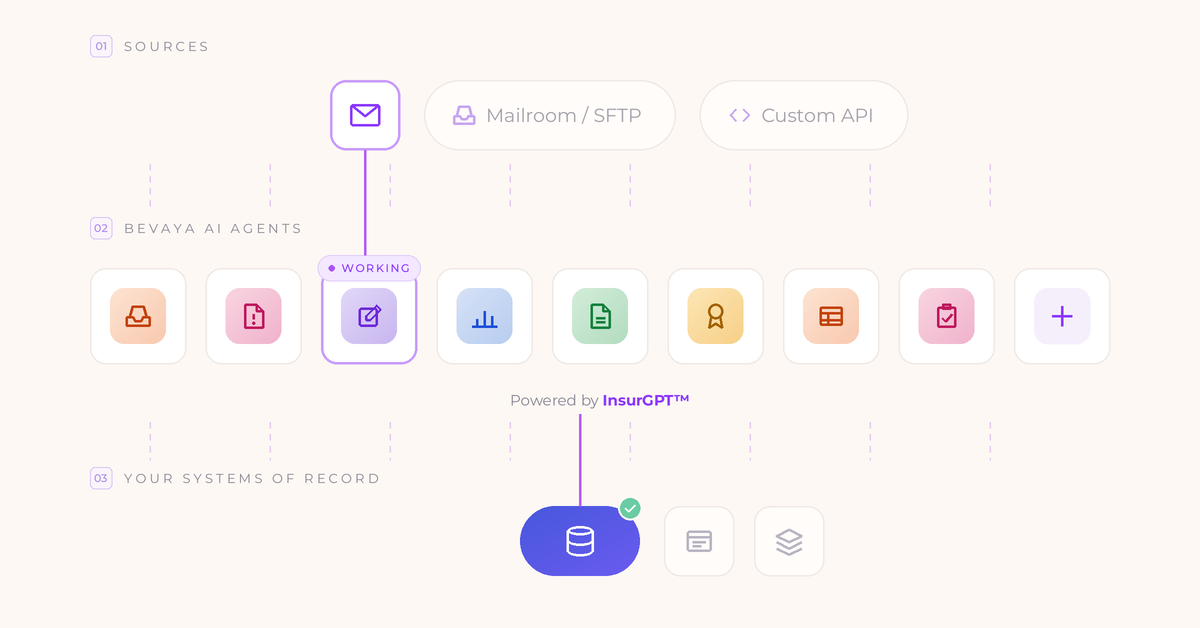
And are your needs, or the AI space, evolving faster than the platform underneath? AI accuracy moves every quarter, while core upgrades typically move on multi-year contracts. When the work arrives unstructured, Bevaya reads it, decides on it, finishes the work, and writes the results into whichever core owns the record, end to end, the way your people already do it. Deployed once, not once per core.
Key takeaways
Look at how the estate got built
Migrations and acquisitions stack up platforms and live versions over the years, and systems rarely get retired.
With Bevaya, nothing gets ripped out
Bevaya deploys on top of the estate you have, whichever core you run.
Three questions decide core or above it
How many systems the process touches, where the work actually enters the business, and whether your needs are evolving faster than the platform underneath.
One layer, every core, end to end
Work arrives unstructured; Bevaya reads it, decides on it, finishes the work, and writes the results into whichever core owns the record. Deployed once, not once per core.
Full transcript
Every CIO opens with the same question. What do I have to rip out? But look at how the estate got built. A migration, an acquisition. Another migration, another acquisition. 12 years. 3 to 7 per program. Tens of millions of dollars spent. Suddenly you have six platforms, nine live versions, and none of them being retired.
So with Bevaya, what do you have to rip out? Nothing.
The real question today is why not just switch on the AI in my core? It's a fair question. Whichever core you run. This isn't an argument against it. The question was never whether their AI works. It's what does it cover?
Three questions. Decide whether a capability belongs inside the core or above it. How many systems does your process touch? If it's only one, embed the AI. If it's more than one, then let the AI sit on top. Most work begins outside your core systems. A submission is an email. A first notice of loss is a phone call. Finally, are your needs or the AI space evolving faster than the core platform underneath it? AI is moving really fast. Accuracy moves every quarter. Core upgrades typically move on a multi-year contract. Can you afford to wait? If the answer is no, let the AI sit on top.
Work arrives the way it arrives: unstructured. Bevaya reads it, decides on it, finishes the work, and writes the results into whichever core owns the record. End to end, the way your people already do it. Deployed once, not once per quarter.
Frequently asked questions
Does Bevaya replace our core system?
No. Nothing gets ripped out. Bevaya deploys on top of the estate you already run, reads the unstructured work as it arrives, and writes the results into whichever core owns the record.
When should AI be embedded in the core versus sit on top of it?
Three questions decide it. If a process touches one system, embed the AI there. If it touches more than one, let the AI sit on top so the capability is deployed once rather than once per system. And if your needs or the AI space are evolving faster than the platform underneath, putting the capability above the core lets it move at AI speed rather than on the core's upgrade cycle.
What about the AI built into our core platform?
It's a fair question, whichever core you run, and this isn't an argument against it. The question was never whether that AI works; it's what it covers. Most insurance work begins outside core systems: a submission is an email, a first notice of loss is a phone call. A capability embedded in one system covers work inside that system.
How does Bevaya fit into our existing architecture?
As one layer above the systems of record. Work arrives the way it arrives, unstructured. Bevaya reads it, decides on it, finishes the work, and writes the results into whichever core owns the record, end to end, the way your people already do it.
Related resources
Get new sessions first
New webinars, customer stories, and product videos from Bevaya.
- New webinars and interviews as soon as they go live
- Customer stories from insurers putting AI Agents into production
- Product walkthroughs of new Bevaya capabilities

