

Webinar
Where Does AI Belong in Your Insurance Tech Stack? (2026)
A panel from Myridius and Bevaya compares where AI can sit in an insurance tech stack and what it takes to run it in production across existing core systems.
About this session
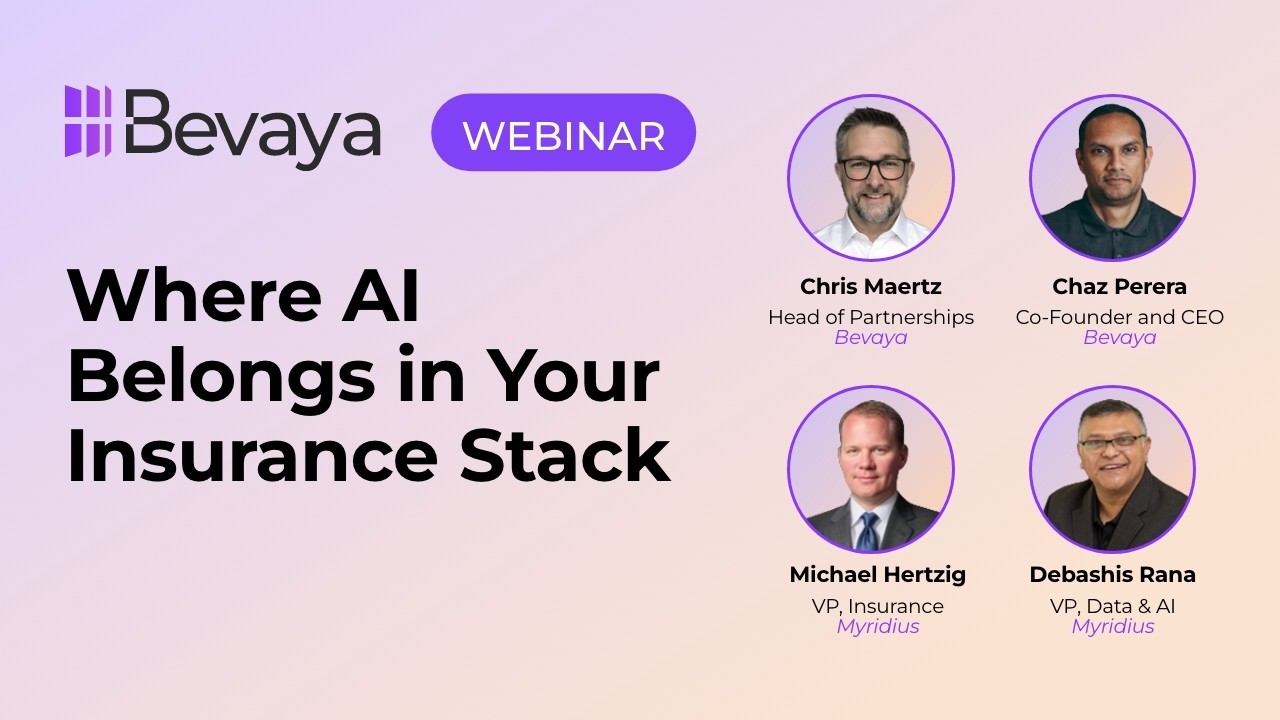
A new claim or submission usually arrives as an email with a stack of attachments. Someone has to read it and turn it into data before any core system can act on it, and for many carriers, MGAs, and TPAs, that work feeds more than one system of record. In this webinar, Michael Hertzig, VP, Insurance at Myridius, and Debashis Rana, VP, Data and AI at Myridius, join Chris Maertz, Head of Partnerships at Bevaya, and Chaz Perera, Co-Founder and CEO of Bevaya, to compare where AI can sit in an insurance tech stack.
This session is for insurance technology, operations, and IT leaders deciding how AI fits alongside their policy, claims, and billing systems. The panel compares AI from core system vendors with AI from dedicated providers, weighs the tradeoffs of each, and looks at what it takes to run AI in production across the systems already in place.
Why it matters. Where AI sits in the stack decides which work it can reach. That choice shapes cost, speed to value, and how many systems benefit.
What you'll learn
Ask who owns the result
If the innovation team owns it, it's a pilot. If the head of underwriting or claims owns it, it's real.
Most work starts in the inbox
Emails and documents arrive before any core system can act, and someone has to convert them.
Carriers run more cores than planned
Midsize and large carriers often run three to six policy systems and two to three claims systems.
Core vendor AI fits a simple stack
One core, on the current release, with the task inside it, is where embedded AI makes sense.
Full transcript
Welcome and panel introductions
Chris Maertz, BevayaThank you for logging on for today's session on where AI belongs in your insurance stack. We welcome back those of you who have attended our sessions in the past. And if this is your first time with us, we're glad you were able to join us today. I'm Chris Maertz, head of partnerships here at Bevaya, and I'll be your host for today's session.
And with that, I'm excited to be joined by Bevaya's co-founder and CEO Chaz Perera, Michael Hertzig, VP of insurance at Myridius, and Debashis Rana, who is the VP of data and AI at Myridius. And today I'll be putting some direct questions to each of them about where AI belongs in your insurance stack, whether it's from your core vendor or a dedicated provider. So, we'll jump right in and get started.
What carriers mean when they say they're doing AI
Chris Maertz, BevayaAnd Michael, I have the first question for you. As you sit across from insurance clients every week, when a carrier tells you they're doing AI, what do they usually mean? And then I'm curious, is it the same thing that you would mean if you said they're doing AI?
Michael Hertzig, MyridiusSure, Chris, when you know who's doing AI, usually it's probably one of three things. First, a proof of concept running in a sandbox, maybe a Copilot license rolled out to a number of staff, or a feature that their core vendor has just switched on. Where I see the true ROI though is redesigning a specific piece of work like submission, intake, first notice of loss, bordereau, reconciliation and where you have a faster or cheaper ROI in production and someone can demonstrate that ROI. How do these often match?
I'd say 20% so one out of five where they say we're doing AI really can point to that production implementation with ROI. Okay. One a quick test I like to use is I ask who owns the result? If the answer is the innovation team still owns the result then to me it's still a pilot.
If the head of underwriting or claims is has that has owns it and has it in their numbers then I say they're really doing AI.
Chris Maertz, BevayaI love that framing about who owns it in order to validate how real it really is.
Where insurance work starts: the inbox
Chris Maertz, BevayaA little different question, but Chaz, you and I talk about this often, but you always talk about where work originates and that it rarely originates in the core system. And I'm wondering if you can just unpack that a little bit and walk through, you know, like what does a piece of insurance work or where does a piece of insurance work actually start its life?
Chaz Perera, BevayaYeah. And Chris, I don't think there's any delineation here between underwriting, policy servicing or claims. Often the work and the judgment decision is h is initiated and occurring outside a core system. A core system might have a diary event that says, "Hey, you need to do X today." But that's not physically how the work starts, right?
The work starts with looking for some sort of documentation from an agent or a broker or alternatively imagine a medical provider or you know I don't know a garage that's repairing a vehicle right that like that's the physical start of the process is that documentation or that conversation that level of engagement that initiates the process. And so I would argue and I have argued that most work in insurance often starts with your inbox as opposed to the core system.
Chris Maertz, BevayaYeah, that's a it's a really good point. I think we're going to keep coming back around that throughout the rest of the discussion today, especially as we get into these next questions here.
How many policy and claims systems carriers run
Chris Maertz, BevayaAnd I'll come back to you, Michael. When you're talking to your clients and when you look across the client base, how many policy admin and claim systems does a typical carrier actually run? Regardless of what their goal state may be, but what's the real what's the reality out there when they look at all the acquisitions and different books of business and everything they're working with?
Michael Hertzig, MyridiusSo for a midsize to a large carrier, I think it's very common to find three to six policy administration systems and two to three claim system still processing live business. And again, you hit on a couple of those. You know, where's this come from? I think first is acquisitions, right?
Usually the acquired book almost never gets fully migrated into the other systems. Second, you've got lines of business that were, you know, never moved from a legacy system to the new system just because the business case didn't justify it. And then you've also got a lot of times legacy systems that are being decommissioned and but it's been going on for eight years or so because again the runoff book or you've got a few hundred complex policies that still live there and then on top of that I think you've got the shadow IT which it you know rating spreadsheets access databases you know MGA and TPA platforms bordereau processes and all these carry you real premium and they rarely show up on your target state diagram that shows you your one or two systems and again I've led global implementations at top 10 carriers I think in every country we went into you know the inventory of systems was much bigger than the plan assumed and again why does this matter because again for AI if the capability only works in one system then it doesn't it only touches part of the book you don't get to all those other shadow systems and additional systems that are still out there processing premium but not part of the you know strategic direction.
Chris Maertz, BevayaYeah, that's incredible and that matches I think what we see in the market as well in terms of the number of systems that people are working with.
Core vendor AI and the CFO's business case
Chris Maertz, BevayaSo Chaz, I'll come back to you. If we take that reality of a number of core systems out there and then think if a buyer if a carrier is buying AI from a core vendor that for a system that only manages part of their book that lives in that system, what does that do to the business case that this the CFO signed off on?
Chaz Perera, BevayaYeah, look, I think it'll be fundamentally difficult to achieve, but mostly because what Michael said, you know, in the latter half of his answer to your question, which is he started talking about rating engines and third party data sources. And if you imagine how a submission from a broker ultimately gets quoted, you're likely touching five or six different sources of information. Certainly the, you know, ultimately needs to get down into a core system, right? That's where things get recorded.
But there's a lot of other sources of that information. Some are state websites, sometimes they're you know underwriting workbenches to give you perspective on the book as a whole. Certainly the submission. So to get to the ROI, you have to be able to bridge the gap across all those things.
And the limit that these core system AI offerings do is assume everything occurs within that single ecosystem. And that's not the world any of us live in. Yeah. Yeah.
Chris Maertz, BevayaNo, that's a good point. So, it's not just the fact that you're if you have multiple systems, you need to configure that same AI in all those different systems and govern it and everything, but you also you still have to reach outside of those systems in order to get the actual work done. Yeah.
Chaz Perera, BevayaOtherwise, otherwise you have a very messy process and you have people who don't understand where things sit within that process and then you get unhappy people. And as soon as you have unhappy people, you have people breaking the core process. And as soon as they break the core process, you have no ROI.
Chris Maertz, BevayaYeah. That's great.
What a commercial insurance submission contains
Chris Maertz, BevayaAnd I want to actually double click on you. You mentioned use submission as an example. And I think it's a good one because that really demonstrates some of the challenges with work coming into an organization anyhow. But what does an actual submission look like?
You know, I think we hear it and we think it's an entry into a core system and it's all there, but like when it actually hits, you said inbox is the usual place that enters, but what's the makeup of that? What are what do you actually need to deal with?
Chaz Perera, BevayaSure. Very quickly, the typical commercial P&C insurance submission, for example, is an email with a series of attachments. That email body contains a lot of instructions that the broker is asking the carrier to consider. Alongside are these attachments.
These attachments are typically one to two ACORDs. It's not atypical to see a supplemental application of some type because the ACORD form doesn't fully reflect everything that's required. Then some type of exposure schedule, right? If it's a property thing, you call it an SOV, if it's an auto thing, you call it a fleet schedule.
You name it, right? Census, if it's healthcare, employee schedule, work comp, etc. And then you're getting a series of ancillary information depending on the product that you're being asked underwrite. That will vary.
You know, if it's D&O, you're probably start to care about things like financial statements, right? If it's property, you start to care about specific information around the buildings that are potentially being insured. My point being there's a lot of variety to it and you have to be able to address that variety without limiting the way it's coming in because you can't predict the way it's coming in.
Claims and policy servicing intake
Chris Maertz, BevayaJust as a followup to that and you actually mentioned this earlier, but I just want I think it's important to acknowledge again we use you just used submission as an example, but I mean if you look across claims and policy servicing, it's really the same problem or is it does it differ for how you have to when it comes to what the work item looks like?
Chaz Perera, BevayaYou know there are aspects of the insurance process that are simple and common across functional areas or parts of the value chain. And then there are other things that are unique to those parts of the value chain. A loss run for example is something wholly unique. But the schedule is something that could be reintroduced not just in underwriting but also in policy servicing.
Right? Just as a simple example of where some things will come up more often than not.
Chris Maertz, BevayaBut the common thread what I heard is regardless of what it is underwriting submission claims policy service request it's a collection of emails documents attachments data coming from all different that needs to be kind of brought together as one work item.
Chaz Perera, BevayaYeah. Look ultimately you know what is an underwriter or a claims adjuster trying to do? They're trying to make a decision. They're trying to use their judgment and experience to make a good decision.
The mechanism to make that decision is data. That data might be sitting in emails and documents. It might be sitting on third-party websites. It might be sitting in the core system.
It might be sitting buried in SharePoint at the insurance carriers within the insurance carriers network. Right? But the point is you need to be able to bring that information to bear at the right moment in time with the right context shaped the right way for that individual to make an informed decision quickly.
Chris Maertz, BevayaYeah.
Who converts unstructured intake today
Chris Maertz, BevayaThat so let's go over you Michael. I mean when you think about that and when we know that work items aren't a simple entry in a database or these complex you know collection of content that's coming in. Who do you see usually doing that conversion at your clients taking that unstructured arrival and turning it into something that the core can actually act on?
Michael Hertzig, MyridiusMost carriers, you know, it's underwriting assistants, it's operations teams, and very often it's an offshore or nearshore team, you know, working through a queue. You know, as Chaz mentioned, right, they open the broker email, which, you know, for every broker it's going to be different. You know, read the form, the schedules, the loss runs. Chaz talked about and then they type what matters into the core and then the other problem is someone else has to check it and I think you know Chaz mentioned a lot of time they you know the underwriters do a lot of that too they reread the submission because they don't fully trust what was keyed in so again you're paying for that conversion twice and then you know on the MGA and reinsurance side it's even more manual I think you know I was with a reinsurance MGA recently whose technical accountant spends about a month every quarter reconcile bordereau by hand and again this caused them to miss their Lloyd's remittance deadline because of it and it showed up in their Lloyd's audit.
So meanwhile you know the cash sat unprocessed for weeks and again that's a one conversion problem that this causes right and so the point of this you know the work's real it's expensive and it happens before the core system ever sees the transaction and so I think you know when people say AI will replace underwriters that you know they're looking in the wrong place I think really the real term value is you know less load on these operations folks and more time for the underwriters to do that decision-making process.
Intake, triage, and rating draw on the same sources
Chaz Perera, BevayaYeah. And Chris and you know, Michael brings up an interesting point here and I'd love to sort of get Debashis's point of view on this because when people think about submission ingestion as one example, they think about the data required in the submission and ingestion process. They don't think about it looking forward. Meaning you need a different set of you need some of the information from before plus additional information from the same sources to do triage and routing.
You need additional information again from the same sources to do rating and quoting and yet everyone thinks of it in this very siloed way and that's a mistake.
Debashis Rana, MyridiusYeah. I mean you know look when we do a lot of these conversions if you will as part of any modernization large transformation exercises at carriers and brokers and you know organizations like that we often you know get asked this kind of question right I mean there is a lot of work that goes into the mechanics of things right meaning it architecturally we think about this as the pattern is the same. I'm going after different kinds of unstructured data like emails and attachments. And by the way, many of these attachments can be zip files with multiple attachments, right?
Very real life examples there, right? But what matters is rather than thinking about these in silos, think about the you know the technological underpinnings as providing you a foundation. But when it comes to underwriting, this is you're really bringing in the context that is relevant to risk and appetite, right? For claims, it's coverage and triage for you know and so on.
So there are different you know to use a partly technical term skills at play right that is going to analyze this information, help with the judgment, make the recommendation and have the human expert ultimately sort of make the call right. So you know and it's one thing to convert your structured data from schema A to schema B meaning going from legacy to the new s the new incoming system but all of this unstructured data that needs to come in. So there are there needs to be strong focus on data quality and what I call content quality or curation right you know you need to know what you want to bring in and where it needs to go right in the target system as well as into the AI layer. So that's
Chaz Perera, BevayaSorry Chris I was just going to add I you know to what Debashis is saying I also think in the context of AI today where you know you live you can live in a multi-agent environment where you can spawn work around the same effort across multiple agents. How do you sequence that so that the work arrives at the agents quote unquote desk at the right time to be able to bring it all together? Like there's a lot of scaffolding so to speak that has to exist to do this well.
Chris Maertz, BevayaOkay. Yeah, I know that's good. So I like if I were to kind of sum up some of what I heard it the core is where work where structured work actually gets recorded but it's the intake where it gets converted and asking a core system to solve that problem maybe doesn't make sense.
Chaz Perera, BevayaYeah. Look, I'm also suggesting by the way and this is just my point of view. Michael and Debashis might have a separate point of view on this. Judgment has to happen with the human, but that judgment has to be shaped so the human can make a good decision quickly. That's not happening in the core system.
Chris Maertz, BevayaYeah. Yeah.
Core system upgrade cycles and the pace of AI
Chris Maertz, BevayaSo, Debashis, I'll come back to you on this one. Thinking of how AI capabilities are changing every quarter and you have core platforms that are on multi-year contracts and upgrades. You know, how should a carrier think about you know, attaching or using AI within a core system that moves at a very different timeline than what we're seeing AI moving at.
Debashis Rana, MyridiusYeah. Well, I smiled when you said every quarter because oftentimes it feels much more rapid than that. That is a very good point right core systems need to have a level of stability given that they're systems of record right so the cadence of that is longer if I can use that you know use the term where AI brings the most value is not within these individual pieces themselves because we are seeing that they rapidly become you know take are becoming table stakes, right? Being able to make recommendations on whether something is within your risk appetite or not.
You know, almost like a pre-underwriting step. And you know, there are multiple examples as you move down the value chain. The real value comes from when you're looking at it more holistically. And Chaz was referring to this just a couple of minutes ago as well, right?
When you look across your book when you are able to establish that global view if you will that's what is driving competitive advantage by using AI right previously we were relegated to engineering kind of approaches and things like that but given the pace at which AI is moving you know that is raising some interesting use cases that carriers quite frankly hadn't even considered going after right but now those possibilities are there right so I would say once again I'll lean back on architecture right we call it loose coupling meaning you know the source systems do what they do you have to have that connective tissue between your AI layer and you know and the core systems if you will but that having some flexibility or some give in that connective tissue really enables you to sort of advance on the intelligence front so that you are doing more business, you are doing you know better business and you know you're making more informed decisions while you get that stability of managing your books using the core systems.
Chris Maertz, BevayaYeah, that's great.
Why insurance AI needs scaffolding
Chris Maertz, BevayaAnd Chaz, I want to come back to you and you know like Debashis just said like saying capabilities are changing every quarter is almost laughable. I mean we see this with our own AI research teams. I mean what do you see has changed in the last 18 months that you know to Debashis's point makes this an architectural question instead of a theoretical one.
Chaz Perera, BevayaSo you know I think models will continue to improve on general knowledge where models don't seem to be improving and I'm speaking here specifically to frontier models is around insurance specific knowledge and we've seen this in our own benchmarking and on and our own research. There isn't you know at best a 1% difference between you know Opus 5 and Opus 5.5 or like even Opus 5 to Fable 5 there wasn't that big a difference on insurance specific things so the this is why I always go back to scaffolding is really important here if you're going to if you're going to build your own agents and build your own AI. You need a scaffolding to build it in a way that you don't have to rip and replace every time you do something new. Every time something new comes forward and really it also gives you the opportunity to scale AI because you have the right infrastructure so to speak.
And I think this is what people mess up. They everyone thinks they can vibe code and yes you can vibe code but you're vibe coding a POC. It's phenomenal as a proof of concept. It's useless as you try to scale to production.
And so that's what I would say like if you want to do this well to answer your question like the thing I the thing I've seen that's really changed is scaffolding that people understand that's what they need then you can build phenomenal AI to solve phenomenal problems to create real ROI and I think that speaks to what Michael said at the very beginning what Debashis has just said as well.
Debashis Rana, MyridiusYeah. And if I can add to that ch you know like really quickly right the general knowledge is fine and your observation is right on the domain knowledge is light and obviously the proprietary knowledge of a firm is non-existent within those you know within the frontier territory. So you know having the rest of the context being fed in the right manner is critical.
Chaz Perera, BevayaMhm. Yeah. There's one thing all the frontier labs are really good at. Coding.
Why? Because they want to eliminate their own coding. That's why that stuff works so well, but it doesn't work everywhere else as well.
When AI from your core vendor is the right call
Chris Maertz, BevayaYeah. All right. Well, let's transition a little bit. We've been talking a lot about some strong reasons for why AI living as its own entity, as its own layer within an organization makes sense because of all the many cores that are out there, the need for it to be able to keep up with all the changes that are happening so rapidly and not be tied to longer upgrade cycles, etc.
But let's flip that around and look at the other side of it and let's you know let's talk about when is buying AI or including AI as part of your core system the right call. You want to take that one, Michael?
Michael Hertzig, MyridiusWe've talked a little bit about I think if you're running one core and you're on kind of the current release and that task lives inside the core and the vendor feature is good enough then I think it's a good option and also again if you don't have the team to govern another vendor I think the simplicity makes sense. I think but again my experience not a lot of these a lot of carriers I run into are on the latest and greatest release of the core because it's you know again they come out often there's a lot of change associated with putting in those cores and it's a mini re-implementation and a lot of times in the cores that you know the AI is in their latest and greatest version if you're not on that latest and greatest version it becomes a challenge but if you are on that and you've got a pretty simplified environment, I think it could make sense.
Chris Maertz, BevayaYeah. Yeah. Yeah. Good answer.
Why agentic AI projects get cancelled
Chris Maertz, BevayaChaz, I'm curious. I mean, statistics are everywhere about how many AI projects are not successful. Gartner expects more than 40% of agentic AI projects to be cancelled by the end of 2027. You know, arguably you could say Bevaya, we're in that category.
But why should a carrier believe we're on the right side of that number?
Chaz Perera, BevayaI would argue we're not in that category, Chris. For no other re for no other reason than you know what makes us unique, I think in this space is we've deployed our AI over 140 times in production at scale. So we're not an experiment. We come with pre-existing knowledge of insurance.
Our models are tuned specifically for insurance and we can get customers the reason that they've been successful is because we can get them to production in a really short amount of time and scale. Why? Again, I go back to we our platform allows you to, you know, imagine the thing you want to imagine if we haven't already done it with some of our pre-built agents. And then quickly using our agent and in natural language, tweak the way that agent works for your particular use case.
Test it thoroughly. It's governed the right way and then you can scale it. And I would say that's not the norm in the insurtech space at least with AI vendors.
Michael Hertzig, MyridiusFrom an SI side. I think the projects we see that get cancelled are really the ones with no clear business owner kind of being run out of a lab and then somebody that's using all clean data as kind of Debashis just mentioned right that once you get into production the data is hairy and complicated and you better have as Chaz said the scaffolding to handle those exceptions because I mean pilots are great if you're running on clean data but with no business owner and no production data those are the ones that I think tend get cancelled.
Tradeoffs of a separate AI layer
Chris Maertz, BevayaYeah. Let me come back to Michael like so given all that what is the honest downside of running AI separately from having it part of the core.
Michael Hertzig, MyridiusYeah. I mean again it's a second vendor to onboard and govern and again you know with the reg and we run in a regulated environment so there's you know security you're going to have to go through AI review you know data reviews on what data you're accessing and that again if you go with your incumbent core you're not even going to go through that sometimes reviewers have to work in multiple interfaces which isn't ideal and the integration cost isn't zero but again complexities kind of moves but it doesn't disappear. But again, you do it because as Chaz mentioned, you can get to the ROI faster and if you do it with someone that's done it before, this comp, you know, getting through that complexity and speed quickly, you get to your ROI faster.
Chris Maertz, BevayaYeah, Debashis, any final thoughts kind of on this topic?
Debashis Rana, MyridiusYeah, I mean, look, I mean, it's important to be clear-eyed about the tradeoff, right? I mean there are certain advantages in certain situations to sort of using native functionality within the core and we've already covered you know Michael mentioned if something is within the bounds of a certain business function as part of the overall value chain and like I mentioned earlier some of these are becoming table stakes why not right but then if you want that broader global view that independent AI layer really comes in handy I want to add one more perspective to this right having done dozens and dozens of these migration projects meaning there is the tool implementation the core implementation for sure but then there is this data migration right and it's you know which I've talked about earlier we are hitting a point where we will also start talking about AI migration because you are leaving a legacy platform that had some form of even if it's nascent AI and it's locked into the tool right And I am foreseeing that is not going to be a straightforward exercise, right? Because some of the crown jewels of the carrier or the broker are right there, but it's baked right in. It's, you know, tightly coupled with their native AI implementation.
Right. So having that independence gives you that flexibility quite frankly.
Chaz Perera, BevayaChris, if I could just double down on Debashis's point because I think Debashis you probably agree with me here that today forgetting like AI migration in the sort of universal sense today if you're if you don't have the right scaffolding and you're forced to move from I'm going to make up you know model X to model X.1. Yep. You cannot assume that the prompts you have in place will work and generate the same outcome that you've been getting from model X. And so you need a mechanism and the people to test it, validate it and make that change.
And that's the stuff where like again it's so important to have I know I say this often like the scaffolding is really what helps you scale.
Debashis Rana, MyridiusAbsolutely. Absolutely. I mean you know there are eval frameworks that are maturing and things like that but those only go so far right so it becomes a larger architectural problem over time and for all the reasons Michael said right in the beginning right I mean the modernization exercise of your core systems might be done in earnest but there's runoffs there's like you know there's growth ambition so for a new line of business you want to get into your present core system vendor doesn't quite offer what you're looking for. So, it's a very organic landscape.
And Chris, going back to your point about the five years versus every quarter, what if those five-year boundaries don't match? So, now you have a continuous loop of change, right? And your migration is going to be forever, right? So, think about the complexity of that exercise.
So in as much as you can you know a stable core but evolving intelligence right so if you think about it from that mindset it makes a lot of sense to have that external AI layer quite frankly
Chris Maertz, BevayaAbsolutely
Three questions to ask your core vendor about AI
Chris Maertz, BevayaSo take let's run with this so now someone's evaluating AI from their core vendor next quarter what are the three questions that they should be asking and what does a good answer sound like Michael, you want to take a stab at that one?
Michael Hertzig, MyridiusYeah, I'm gonna you sound like I'm repeating myself, but I'm going to say, hey, does it cover business sitting in my other systems, right? So, if you have multiple cores, you know, can it handle that? I think a good answer to that names, you know, an integration approach and maybe a reference customer that's running more than one core. Second, I would say, you know, what release and hosting do I need?
Do I need to be on the latest release of the core? And does it need to be in the cloud and what will it cost me to get there if as we talked about maybe you're not on the latest version of that particular core system and last you know I think Chaz just hit on it how do I govern it and what do I do if I need to get out of it right and that good answer covers audit trails how do you explain you know model transparency and the ability to swap or switch that model if for some reason I want to move from model X to model X.1 want.
Debashis Rana, MyridiusYeah. And you know, I would add to that. I mean, really what the question you're asking is this AI capability that you're giving me and you're telling me is native, right? Is that a product in and of itself or is it something a little looser than that?
Is it a demo wearing a product hat? Because you know, not to name any names or anything like that, right? But the whole practitioning community as I call it is learning through this whole process right and if you go back to the 5-year versus every quarter the cadence itself is different how is the core vendor accounting for that themselves in their native capability.
What the market gets wrong about AI in insurance
Chris Maertz, BevayaGreat. So I want to wrap up with each of you and then we'll jump into Q&A but I'm going to ask you each for one sentence. One sentence and that set that the sentence answers the question what's the thing that the market is getting wrong right now about AI insurance if anyone feels ready I'll start with them otherwise I'll pick sorry Michael
Michael Hertzig, MyridiusAll right I think you know everyone is budgeting for the model but almost nobody is budgeting for the data cleanup and the change management to actually make it work.
Chris Maertz, BevayaLove it. Love it. Debashis.
Debashis Rana, MyridiusVery similar to that, you know, do not underestimate the effort it takes to really get your data and its quality AI ready and the content and curate that aspect as well to be AI ready.
Chris Maertz, BevayaChaz, what do you think the market's getting wrong?
Chaz Perera, BevayaI think they're Michael said it, Debashis said it early on. I think they're just picking the wrong processes to automate, right? Pick the processes that have the most ROI. That move the needle for your business.
If it's growth, how is it going to impact growth? If it's cost cutting, how is it impacting cost cutting? Versus picking the safe thing because you want to try AI. Sure, you'll prove that you can do AI, but that's not the underlying challenge.
Michael Hertzig, MyridiusGreat. So moving on to that as well because again I think there is an operating model change that they need to consider right it's not just the tech I mean there's the people and then that operating model should change if you're really going to see that ROI
Chris Maertz, Bevaya100% 100%. Well guys, this has been fantastic discussion and as we've been chatting some questions have come in.
Q&A: Using AI during a core modernization
Chris Maertz, BevayaSo I'd like to pivot over to do some Q&A and the first question came in and it is we are midway through a core modernization project. What can we do to utilize AI today? So sounds like you know they're not on that latest version yet but they want to get there. So, Debashis, you want to take a stab at that one?
Debashis Rana, MyridiusAbsolutely. You know, I would say first and foremost, you need to target that work that sits before where the core system takes over like Chaz was describing it, right? Because that is still work that needs to be done, right? And the work around the core, right?
And then I've talked, you know, more than once about this whole data migration process. You know, now is a great time to really, you know, get AI to look at the schemas in the old and the new, look at the data in the old, look at the content in the old, right? And, you know, AI can do a lot of things these days, you know, data discovery, doing your mappings and all those other things. Get those aspects of it ready, right?
And then you know last but not the least you know is to really look at it from a standpoint of you know can you now take this opportunity to really not throw out the baby with the bathwater. We've helped a number of clients where this has often times become a great trigger to build out a data lake or a lakehouse. Right? Because from a regulatory standpoint, you've got to have a certain amount of history, but you have a lot of hidden nuggets going back even further than that, right?
Either add to if you already have a lake or a lakehouse, it's a great opportunity to do that. So, we have oftentimes used the lake environment as being that conversion platform itself quite frankly. So, it serves a dual purpose.
Chris Maertz, BevayaYeah. Great. Great.
Q&A: One claims core and one policy core
Chris Maertz, BevayaLet's take another one here. And I think Michael, you'd be a good one for this given what you were talking about, how many cores you see. So, this question is, they have one core, or one core for their claims and one for policies. Would you still recommend a separate AI layer? It's a pretty clean setup.
Michael Hertzig, MyridiusAnd I think I would ask three questions again. First, you know, where does the work you want to improve actually start, right? If it's inside the claim system like reserving adjuster notes I think then the claims vendor AI may be all you need again but if it starts in the inbox like it's submissions or FNOL documents again that's before either core sees it I think second does the task need multiple systems mult systems things like coverage verification on a claim fraud signals or renewal decisions that use loss history from policy and claims together. That's, you know, again, a layer that sees both of those may be advantageous.
And third, again, gives back to my release thing I keep harping on. Are you on the current release for both? Again, if embedded AI, you need to do an upgrade to your core systems, then I think a separate layer may get you to value sooner. So again, if the answers are inside the core, one system current release, I think go with a vendor.
If not, then I think this other layer may get you to value faster.
Chris Maertz, BevayaYeah, really clear, easy, you know, decision tree to follow there. Thank you.
Q&A: Our core vendor already has our data
Chris Maertz, BevayaAnd I think we got time for one more, so we'll give this one to Chaz. Let me read it first. Make sure it's a good one. Our core vendor already has all of our data.
Wouldn't that make more sense to use their AI capabilities? Chaz, you want to?
Chaz Perera, BevayaIf they do, absolutely. But do they really have all of your data? Right. I think you know Debashis has talked about the data lake and it reminded me when I worked at AIG we would often talk about the data lake and my argument was like we have documents that we've stored in the data lake but we don't actually know what's contained in those documents.
And it wouldn't surprise me if there's a lot of structured data and some unstructured data like adjuster notes for example in the core system. But is that the totality of the data you need to make a decision? Lest we forget people have a tendency to only put the minimum required information into a system to move to the next step.
Chris Maertz, BevayaYeah, great point. Great point.
Closing thoughts
Chris Maertz, BevayaWell, we as we wrap up, I just wanted to do kind of again rapid fire go around to each of you. I'll start with you, Michael. Closing thoughts on where we're at, how to think about AI in the insurance space.
Michael Hertzig, MyridiusAgain, I think you again focus on the ROI and you really make sure you're thinking about all parts of the problem because again, a tool, it's a great tool that can help, but really where the real ROI is in making those better decisions faster and again leverage what where the strengths are in the core. It's the data that sits in. I think there's a lot of value in AI around all that data that's not stored in the core because it's more of a transaction system. It's not meant to, you know, harvest all that other data.
Chris Maertz, BevayaChaz, final thoughts.
Chaz Perera, BevayaPick I think that the three of us, Chris, have said it in many different ways, which is just pick the right thing to start with. Yeah. That creates real value for you and then you know everything else can be smooth but you got to pick the right thing to start with.
Chris Maertz, BevayaYeah, Debashis.
Debashis Rana, MyridiusYeah, I'll build upon what Michael and Chaz have said, right? I mean, we see a lot of organizations go through this exercise of assembling a list of use cases, right? But what I would recommend is take a really hard look at those use cases. Oftentimes they're not AI use cases, right?
And a simple rubric might help address that, right? You know, a lot of times it's an analytic exercise, it's an automation exercise. In some cases, smart engineering can solve the problem. Not everything is an AI problem. So, keep an eye on that.
Chris Maertz, BevayaTotally agree. Totally. Yeah. Well, this has been great and I think, you know, some of the takeaways I'm gonna leave here with.
Michael, I really loved your framing of how to know if a project is real or not and you know, who owns it. Is it sitting with the chief of claims, chief claims officer or is it still in the innovation team as an experiment? I love that and you know, Debashis, actually that last thought on just not everything needs AI and it doesn't it's not always there and Chaz certainly you know pick the right problem and you're going to have much better success. So, we're going to wrap up there.
So, so thank you to our panelists and we appreciate everyone making time to join us today. You know, thank you to the Myridius team for sharing their expertise and of course to our very own Chaz Perera.
And with that, we hope to see you again soon and have a great rest of your day. Thank you. Thanks for having us. Thank you. Thanks, guys.
Frequently asked questions
Where should AI sit in an insurance tech stack?
AI should sit where the work starts. Chaz Perera, Co-Founder and CEO of Bevaya, argues that most insurance work starts in the inbox, with emails and documents that must be converted before any core system can act. An AI layer that works across systems reaches more of that work than AI built into a single core.
When does AI from a core vendor make sense?
Core vendor AI makes sense when you run one core system, you are on the current release, and the task lives inside that core. Michael Hertzig, VP, Insurance at Myridius, added that the simplicity also helps teams without the capacity to govern a second vendor.
How many policy and claims systems does a typical carrier run?
Midsize to large carriers commonly run three to six policy administration systems and two to three claims systems, according to Michael Hertzig of Myridius. Acquisitions, lines never migrated, long decommissioning projects, and shadow IT keep them in place.
What should you ask a core vendor about its AI?
Michael Hertzig of Myridius suggests three questions: does it cover business in your other systems, what release and hosting does it require, and how do you govern it and get out of it. Good answers name an integration approach, a reference customer running more than one core, audit trails, and the ability to swap models.
Related resources
Get new sessions first
New webinars, customer stories, and product videos from Bevaya.
- New webinars and interviews as soon as they go live
- Customer stories from insurers putting AI Agents into production
- Product walkthroughs of new Bevaya capabilities