



Product
Why Your Second Insurance AI Agent Is Easier to Build
Your first AI agent builds the connector, schema, review layout, rules and prompt. See how every agent after it reuses that work and builds only what's new.
Video not playing? Switch video player.
About this video
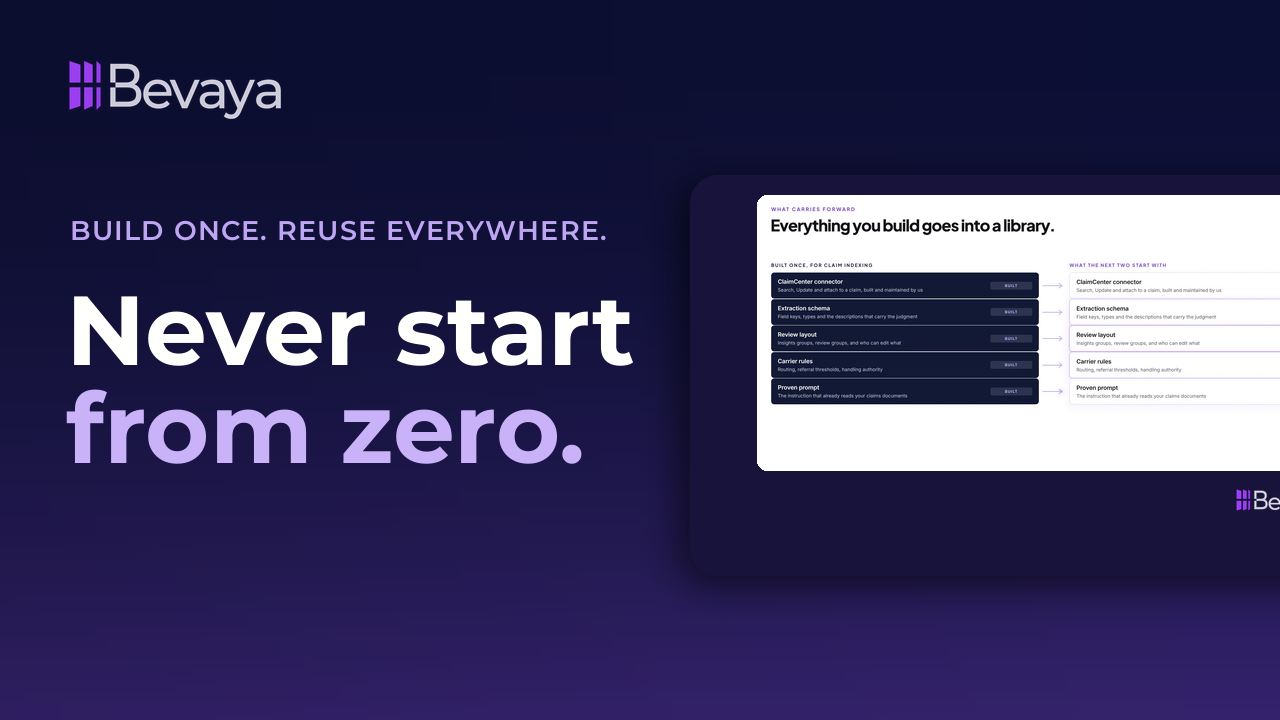
Your first insurance AI agent does the most work. It connects to your core system, defines the extraction schema, lays out the review screen, encodes routing and authority rules, and proves the prompt that reads your documents. This short product video shows how every agent after it starts from that work.
The example follows three claims agents on Guidewire ClaimCenter. Claim indexing builds all six parts. FNOL and FROI setup reuses them and tweaks only the flow. Legal demand management adds its own rules for statute deadlines and settlement authority. Everything goes into a library, so your team gets faster with each agent. It's for operations, claims, underwriting and IT leaders at carriers, MGAs and TPAs planning their next AI agent.
Key takeaways
The first agent builds everything
It connects to your claim system, defines the extraction schema, lays out the review screen, encodes routing rules and sets up the prompt.
The next agent changes only what's different
FNOL setup reuses the same six parts with a few tweaks to the flow. Legal demands also need their own rules for statute deadlines and settlement authority.
Everything you build goes into a library
Connectors, field definitions, review layouts, routing and authority rules, and prompts carry forward, so the next agent starts from everything you already proved.
Your team gets faster over time
New use cases like claims file summarization or medical bill review inherit the work of the agents that came before them.
Full transcript
Here's what makes the second claims agent easier than the first. Claims indexing typically goes first, though it doesn't have to. So, it builds everything. Connect to your claim system, define the extraction schema, lay out the review screen, encode the routing rules, enhance your prompts and other gates in your flow.
FNOL setup has the same six parts and only the flow requiring a few tweaks. Legal demands require adjusting two things because demand packages need their own rules and gating. For example, changing statute deadlines and settlement authority.
Everything you build in Bevaya goes into a library. The connectors, the field definitions, the judgments, the review layouts, your routing and authority rules, the prompts, etc. So the next agent does not start from zero. It starts from everything you already proved.
Three agents, one claims family, five shared assets, and new use cases like claims file summarization or medical bill review all inherit the features of the use cases that came before them. So your team gets faster over time, not slower.
Frequently asked questions
Why is the second insurance AI agent easier to build than the first?
The second agent reuses most of what the first one built. The connector, extraction schema, review layout, routing and authority rules, and prompts carry forward, so the new agent mostly needs its own flow.
What carries forward from one AI agent to the next?
Five shared assets carry forward: the system connector, the extraction schema, the review layout, routing and authority rules, and proven prompts. In Bevaya, everything you build goes into a library that the next agent starts from.
What changes when you build a new claims AI agent?
Usually the flow, and sometimes the rules. In the video, FNOL setup needs only a few flow tweaks. Legal demand management also adds rules for statute deadlines and settlement authority, because demand packages need their own gating.
Does this approach apply outside claims?
Yes. The video uses three claims agents as its example, and the same reuse applies to any group of agents that share a core system and document types, across underwriting, claims and policy servicing.
Related resources
Get new sessions first
New webinars, customer stories, and product videos from Bevaya.
- New webinars and interviews as soon as they go live
- Customer stories from insurers putting AI Agents into production
- Product walkthroughs of new Bevaya capabilities

