


Nearly every commercial submission starts with an ACORD form, and every quote can stall there. An underwriter or admin keys 60 or more fields per submission by hand, which takes 10 to 15 minutes on a clean form before anyone even looks at the risk.
AI ACORD form extraction reads the form the moment it arrives, pulls every field with a confidence score, and lands clean data in the underwriting workbench, so the file is ready for a decision rather than a data-entry task. It's one of the clearest entry points for submission intake automation, and a foundational piece of AI for underwriting more broadly.
"Reads the form" actually describes several stages of insurance document processing working together. Knowing what each one does helps the underwriting team ask sharper questions and trust the data that appears in the workbench once one is deployed.
How AI Extracts Data From an ACORD Form
AI ACORD form extraction runs as one continuous sequence, not a single scan-and-done step. The AI agent:
-
Receives the form from any source. Email, broker portal, mailroom, SFTP, or API, the AI agent picks it up the moment it arrives. Nothing changes for the broker sending it.
-
Identifies the form, edition, and variant. Whether it's an ACORD 125 commercial application, a 126 general liability form, a 130 workers' comp form, or a 140 property section, the AI recognizes what it's looking at regardless of state variant, year revision, or broker customization. It catches supplements and attachments sent alongside the main form too.
-
Reads any source quality. A form that's clean, faxed, photographed, handwritten, or pasted into an email body gets read the same way. Insurance-trained AI is built to handle the real-world image quality that generic tools can't parse, including bad scans, low-resolution faxes, and margin notes.
-
Extracts every field for that form type. On an ACORD 125, that's applicant information, premises, prior carriers, loss history, and coverage requested. On a 126 or 130, it's class codes, payroll, operations descriptions, additional insured detail, and experience modification. On a 140, it's location schedules, construction details, protection class, and building values.
-
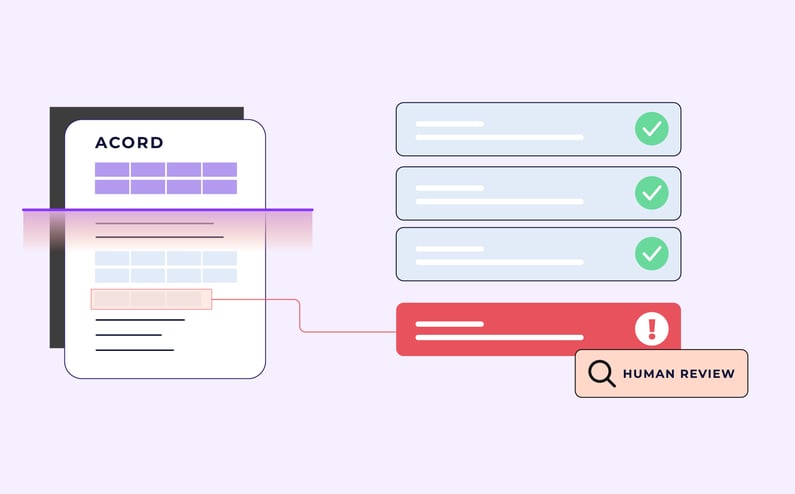
Scores every value for confidence. Each extracted field carries a confidence score from 0 to 100 and links back to the exact spot on the source page, so an underwriter can see what's certain and check anything else in seconds.
-
Validates across the submission package. The ACORD gets reconciled against the loss runs and the statement of values before an underwriter opens the file, catching a mismatched address or a NAICS code that doesn't line up.
-
Runs external lookups automatically. SIC, NAICS verification, and ISO data get checked automatically, along with address normalization, instead of one lookup at a time by hand.
-
Routes low-confidence fields to a reviewer. Anything below a configured threshold, or flagged by a business rule, goes to a human reviewer instead of straight to the underwriting workbench. A reviewer sees exactly where the AI found the value, confirms or corrects it, and the correction feeds back into the model.
-
Lands clean data in the workbench. By the time a submission reaches the underwriter, it's already identified, extracted, reconciled, and checked.
AI ACORD Form Extraction Cuts Time to Quote
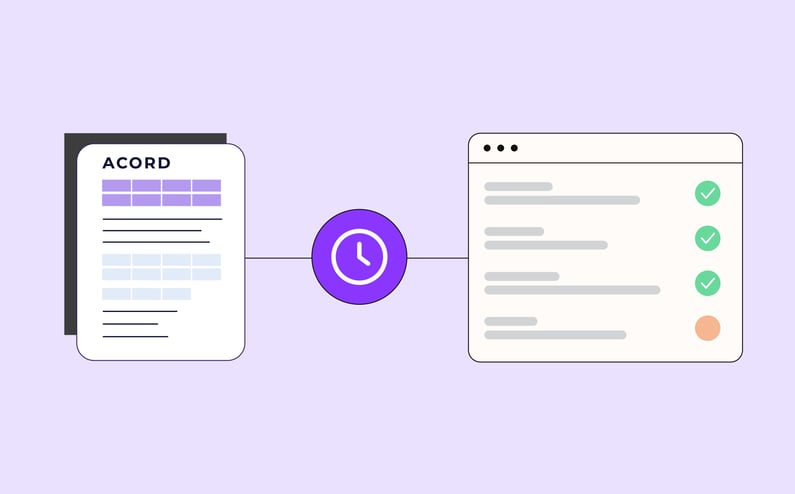
Speed alone isn't the point. A tool that only extracts data faster can still hand an underwriter a fast, wrong file if nothing checks that data against the rest of the submission. The real value of ACORD data extraction is what disappears from an underwriter's desk before they ever see the file. No sorting, no re-keying, no chasing down a mismatched detail on their own.
Submissions that used to sit in a queue for hours can reach an underwriter within minutes of arriving. Brokers notice that difference, and turnaround speed increasingly decides which carrier gets first look at a risk. Because the data reaching the underwriter has already been reconciled with the rest of the package, faster does not mean looser. The file still holds up to the same risk-selection standards, minus the delay of getting there.
That's what moves time to quote, submission throughput, and ultimately bind rate. It also means the underwriter still owns price, terms, and the bind decision. The AI agent clears the path to that decision. It doesn't make it.
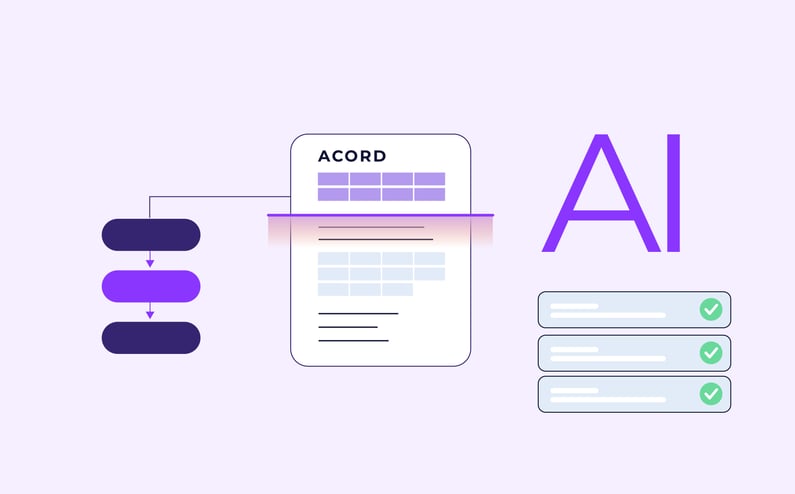
AI ACORD form extraction takes data entry off an underwriter's plate. Every minute an underwriter saves on transcribing a field, they spend on the judgment call that decides whether they write a risk well.
That's what it means to hand an underwriter a submission they can act on immediately instead of double-checking first. That speed is what actually grows a book of business.
