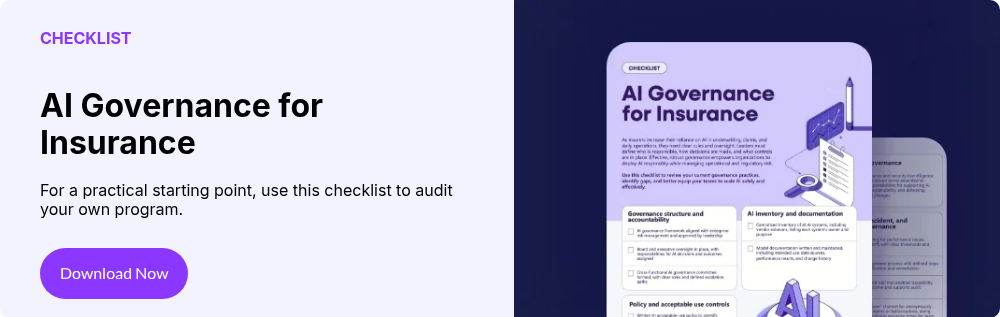



By now, most insurance leaders have heard they need AI governance in place. What almost nobody explains is what that actually means day to day, or how a team knows whether the program it built is working. Most insurers can describe their AI governance policy in a sentence. Far fewer can point to a number that proves it's holding up in production every week.
Insurance AI governance metrics, the KPIs that show a program is working, are how insurers close that gap. They aren't a compliance checkbox. They're the evidence that a program is doing what it claims to do, whether the question comes from a regulator, an auditor, or a customer affected by an automated decision. Knowing you need governance and knowing whether you're doing it right are two different problems, and only real measurement solves the second one.

Regulators and Risk Are Both Driving AI Governance Now
Governance isn't only about passing an audit. It's also what keeps an AI system doing what it's supposed to do once it's live. Two pressures are driving insurance organizations to take measurement seriously, and they come from different directions.
-
AI systems fail without oversight. An agent with too much data access can leak sensitive customer or claims information. A model can get less accurate over time and nobody notices until customers start complaining. A workflow can keep running old, unapproved logic on real transactions because nobody caught the update. These are real failures, not exam findings, and they cost money and trust whether or not a regulator ever gets involved.
-
Regulators expect proof, not promises. State market-conduct exams now ask insurers to show a written AI governance program covering senior-management accountability, model testing before deployment, and ongoing monitoring after go-live. An insurer that can't produce those artifacts on request faces corrective action plans, fines, and follow-up exams, no matter how well the model performs. Examiners are asking for paperwork, so they still flag a strong model that has no documentation behind it. MGAs, TPAs, and brokers face a version of the same pressure. Carriers now build AI governance requirements into vendor contracts, risking business, not just an exam.
Both pressures point to the same answer. An insurer needs numbers that update continuously and show, in real time, whether an AI system is behaving the way it's supposed to. That's what the metrics below are built to do.

The KPIs That Prove AI Governance Is Working
You need to know whether the AI got it right, whether the decision behind it is traceable, or whether quality holds as automation scales. These six KPIs are what turn “we have an AI governance program” into evidence that holds up when a regulator, auditor, or your own compliance team asks to see it.
-
Volume. This metric tracks how many work items ran, and how many of those are actually being watched by the governance program. The first number shows scale. The second shows whether that scale is under control, since work nobody's watching doesn't look like a problem until it already is one. A governance program that only reports total volume, without knowing how much of it is actually being tracked, is answering half the question.
-
QA score. This measures how well the AI did against verified ground truth (what you know is actually correct). It looks at the fields a human had to check, meaning the fields where confidence fell below your set threshold, tracked field by field, month by month. Because you control where that threshold sits, you also control how much lands in this number. Raise the bar on a field you care about, and more of it gets checked and shows up here. That makes QA score less a verdict on all your data and more a tool that shows you what to fix. It shows which flagged fields are getting it wrong, so extraction can be tuned to cover more ground correctly, faster.
-
AI agent success rate. Every AI system routes some work to a human rather than resolving it on its own, sometimes because of a business rule you defined (for example, requiring a human look whenever a claim number is missing from a document, even if the model correctly found nothing there because there was nothing to find), sometimes because a field's confidence fell below your set threshold. Success rate tracks the portion the agent handled correctly within those parameters, meaning it followed your rules and did exactly what it was configured to do. A rising success rate as a deployment matures is one of the clearest signs the model, and the humans reviewing its output, are getting better together.
-
No-touch rate, paired with QA score. No-touch rate tracks how much work goes through with no human touch at all. What makes it meaningful is that you set two levers that move it: the confidence threshold on each field, and any business rules you define for how specific cases should be handled. That's what turns this pairing into a working console instead of a warning light. Use QA score flagged fields as ways to improve prompts, set the right threshold by field, route genuine edge cases to a human through business rules, and dial automation up once you're satisfied with what the QA score shows. When the two numbers hold steady together as automation scales, the program is working as intended. When no-touch climbs while QA score falls, that's telling you it's time to revisit a threshold or rule.
-
AI agent time. This metric tracks processing time per work item, binned and trended on a regular cadence. This is the metric most governance programs skip, and it's often the first place drift shows up, whether that’s the model’s performance changing because the underlying data shifted, or a change to the workflow logic itself that nobody flagged. A model that starts taking longer per item, or shows a growing spread between its fastest and slowest cases, is usually signaling a problem before the QA score catches it. Watching this trend early gives a team room to investigate before an outlier becomes a pattern.
-
A traceable audit trail. The metrics above tell you whether a model is performing. They don't answer the question a regulator will eventually ask: how was this specific decision made, and who is accountable for it? Every extracted value, confidence score, and reviewer action needs a source that's one click away, not one ticket away. Teams need to enforce role-based access control at the organization, workspace, and project level, and lock every published workflow version so production never runs an untested draft. This is where a lot of insurance teams discover their governance gap isn't in the policy. It's in the plumbing.
Tracking these six metrics only works if the platform generates them as a byproduct of normal operation, not as a separate reporting project someone assembles by hand. A team pulling these numbers by hand every quarter is already behind, because the numbers arrive too late to catch a problem before it compounds. The infrastructure behind the metrics matters as much as the decision to track them.

A policy document sitting in a compliance folder doesn't prove good AI governance. Numbers that update every month and hold up when someone outside your organization asks to see them do. QA score, success rate trends, no-touch rate paired with quality, and an audit trail that traces back to the source document are what turn “we have an AI governance program” into “here's the evidence it works.”