


Interview
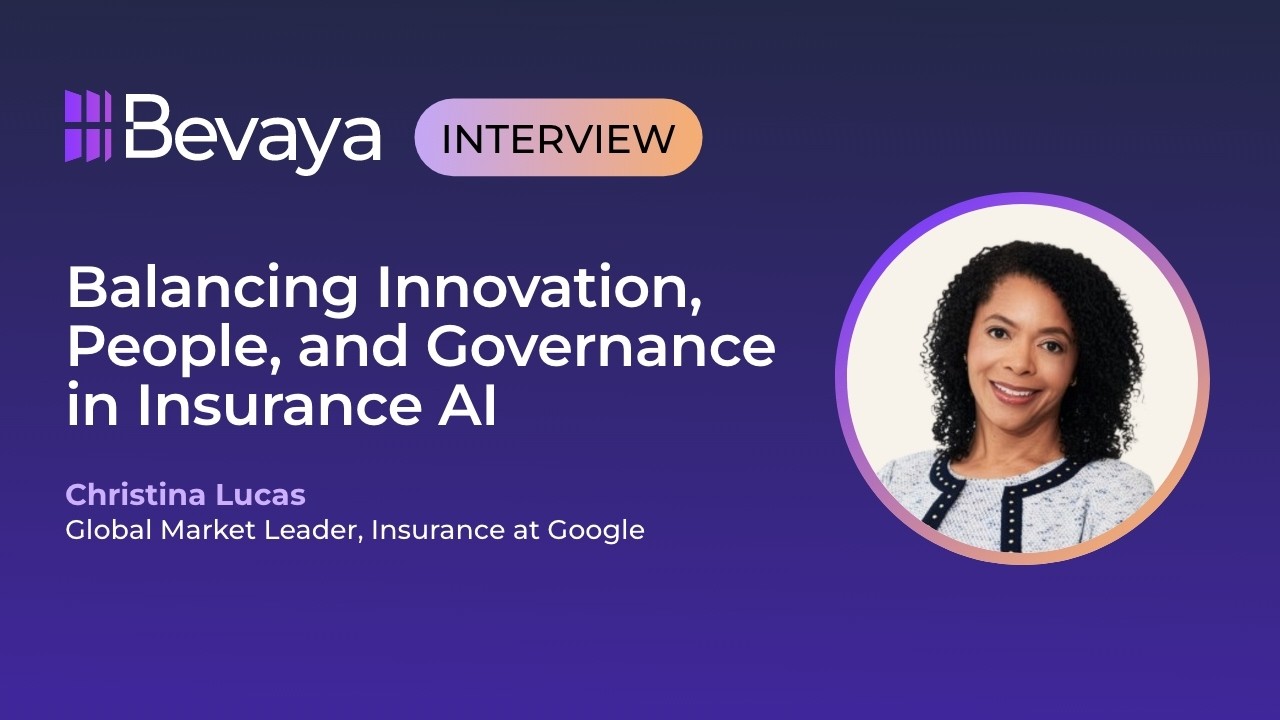
Balancing Innovation, People, and Governance in Insurance AI
A conversation with Christina Lucas, Global Director and Market Leader for Insurance at Google Cloud, on where innovation is paying off, what it means for the people doing the work, and how to govern AI that insurers can stand behind.
Video not playing? Switch video player.
About this conversation
Christina Lucas, Global Director and Market Leader for Insurance at Google Cloud, discusses how insurers can balance AI innovation, workforce readiness, and governance as adoption accelerates.
Christina reflects on her years on the carrier side before moving into the ecosystem, and shares what she is seeing across insurers worldwide from her current seat at Google Cloud. Drawing on her background running claims operations at AIG, she talks about how insurers are rethinking talent and training as AI takes on more entry-level work, how capturing institutional knowledge can help offset a coming wave of retirements, and how leaders can balance innovation with the governance and regulatory expectations that come with a highly regulated industry.
Why it matters. Insurance leaders are at different points with AI. Some are still figuring out where to start. Others are working out how to scale it well. This conversation explores how insurers can innovate with AI while keeping their people and their regulatory obligations front and center.
Key takeaways
Pair a sandbox with governance
Insurers that give employees AI tools inside a governed framework move fastest.
Capture knowledge before it retires
With 40% of the claims workforce nearing retirement, agents can hold institutional expertise.
Coach new hires in real time
Live AI coaching helps junior staff handle hard claims calls with confidence.
Scale with business and IT together
Lasting AI needs appetite from business leadership and IT leadership alike.
Full transcript
Introductions
Chaz Perera, BevayaHi everyone. Artificial intelligence has moved from experimentation to execution across the insurance industry and leaders are now focused on how to scale it responsibly and effectively. It's my pleasure to welcome Christina Lucas, the global market leader for insurance at Google. Today we will explore how AI trends are shaping underwriting claims and operations.
What distinguishes real production value from pilot activity and how insurance insurers are balancing innovation with governance and regulatory expectations. Christina, thank you for joining me today. To get us started, can you give us a little background on yourself and what your role in the industry in the insurance industry focuses on today?
Christina Lucas, Google Cloudyou know AI is in the news every day and every which way and it's really exciting to kind of talk about how it's being used in the insurance industry. so I'm Christina Lucas. I'm the global go to market leader for Google cloud. my background I worked on the carrier side for a long time.
I worked in AIG mostly overseas over the years. I worked in Latin America. I ran claims ops. I lived in Asia for a couple of years as well.
I ran the shared services for Europe and then kind of more broadly claims operations. Then I moved over and I worked actually moved over to the ecosystem side. And so it was really great for me to have one customer view or one carrier view. And then what I've really enjoyed over the last probably five years of my career is actually sitting in different seats around the insurance ecosystem and seeing it from the outside and seeing it across carriers.
And what's really great about my role here at Google now is that I get to work with insurance companies around the world who are all really trying to figure out like how are they going to use AI and what are the use cases to use it and how to deploy it and how to make it stick right and how to get the ROI on it.
Chaz Perera, BevayaHaving started your career inside an actual carrier must help because you've worked in that environment yourself and you can bring that experience to the table.
Christina Lucas, Google CloudI have the the triumphs and the scars. So, victory and kind of like coming out on the other side as well. So, we'll get through it. We'll get through it.
What insurance leaders are asking about AI
Chaz Perera, BevayaTriumphs and scars indeed. you work with people all over the world and talk with many executives and leaders. What types of conversations are you having most often with them today about AI?
Christina Lucas, Google Cloudit's a really great question and it varies slightly by a market you know American market or the Americas even you know versus Europe versus Asia but in general there's it's I'll take a step back actually it's interesting because I've seen over the years where technology was really seen as a support function an enabler for expense reduction and so you focus technology on kind of back office or operational capabilities really to cut cost and create capacity in those functions, but really a lot of the intellectual capital kind of laid outside of tech. you maybe looked at ways you could standardize, but you were still thinking the intellectual capital kind of sat in somebody's brain, you know, fully that are around kind of the operational kind of efficiency or administrative plays as well. But even on the claim side as an example you see a much more focus around how to reduce for instance leakage out of the process you know fraud detection the recovery the subrogation piece of it and then on the underwriting side of course we see just some amazing use cases that come out on how do you really enhance or augment that underwriting process you know whether that's through triage whether it's taking in a lot of different unstructured data types very quickly and getting insights and analytics into it. How can you help to price that policy much more quickly?
How do you model the risks that are there? Especially if you think about emerging risks in nat cat or even cyber. So you see it much more being leveraged as almost an actuarial tool to be able to support the underwriting process versus just kind of a back office play. so that's probably what I'd say in the last couple of years has been a really big transformation around how AI is being used.
Claims first, then underwriting, distribution, and nat cat
Chaz Perera, BevayaAnd in the US, we've tended to see it applied more on the claim side first with organizations moving into underwriting more gradually. Is it the same overseas or do you see a different picture?
Christina Lucas, Google Clouddefinitely claims and especially you know the intake or straight through processing if you think about simple personal lines the fraud waste and abuse you know the FWA piece I'm going to you talk about more broadly it also depends on the market and the model I mean in in for instance APAC even in you know parts of Europe the distribution model is a focus how do you sell more cross-ell upsell really understanding your customer and looking for signals to be able to understand what products are might be important to them that you can present to them. And so the distribution piece is is a huge investment part that that we see as well. and then I would say thirdly the nat cat you know is impacting whether that's the Americas you know across Europe as well you know parts of Asia how do you on the underwriting side how are you modeling for that whether it's flood risk you know hail wind fire in different parts of the world what are the models to be able to do that how do you just help your employees kind of innovate better in order to allow them to innovate right much more quickly and to create their own tools within kind of a framework and governance structure to be able to deploy AI much more agile in an organization.
Governance, sandboxes, and empowering employees
Chaz Perera, BevayaUnderstood. as companies roll these tools out, governance clearly becomes a becomes a huge of huge importance across the Americas and elsewhere. Are organizations really putting solid governance structures in place or are many still trying to figure out what these pieces are?
Christina Lucas, Google CloudOne thing that we do in insurance is we put governance and structure around everything. and so I think that you know to that point though creating the sandbox creating the framework so that whatever your kind of corporate culture is for innovation to be able to allow that blend of a bit of creativity of experimentation coupled with you know a framework to do that whether that's a monthly governance committee whether that's just creating a sandbox letting people play in that sandbox and then kind of share it upwards. the companies that I see having the fastest cycle times to put new AI capabilities whether it's deploying it internally you know or onto the marketplace are the ones that are really enabling their employees to do it if you think about you know the different generations that are in the workplace now you know gen millennials and gen z's and Gen Alphas even they're born digitally native, right? And so if we kind of if I put kind of the old ways of working on top of like how you're supposed to innovate in AI when you've got people who are born with kind of cell phones and iPads in their hand and able to create little apps, we're really holding back kind of that huge talent that's within an organization that can also help to drive the change in innovation. So when I see companies that do it well, they kind of try to get licenses out for instance to you know the Gemini and other tool out into their employees hands giving them a framework to be able to do so giving them some training around it then letting them create and innovate and come up with ideas about ways that they can help solve their day-to-day problems first and then from there you know of course there's going to be enterprise or customer you know facing innovation as you know,
Security when employees use AI tools
Chaz Perera, Bevayaand as as you're giving these employees these tools and encouraging them to be creative, but what about security around that? It's it's it's enormous. Organizations have been hit with ransomware and, you know, lost a week or more of operations. How should companies think about security here?
Christina Lucas, Google Cloudwhen you're giving your employees your AI tools, of course you're going to work closely with your IT team and you know whether you have a a partner as well and making sure that it's in the right secure environment that it's grounded in your data, right? You don't want your customer data to get out and that you're just putting the right controls in place similar to you would any other system that your employees are working with. so that it's protected, it's safe, you're using your own data, and you're kind of keeping the bad guys out. so the the same rules are going to apply on a different scale, and it's just making sure that you're working with the right partner to be able to do that in a way that's protecting, you know, your intellectual capital, you know, your assets, etc. But that being said, you know, everybody is kind of using AI in their personal lives.
So I think it's very important that companies do address this quickly and make sure that they're giving their employees the tools to be able to do it in a grounded secure you know environment so that they're doing it there and not doing it on the side.
Where AI initiatives stall versus succeed
Chaz Perera, BevayaThat's great Christina and you know with AI initiatives where do you see companies struggle or stall versus succeed?
Christina Lucas, Google CloudIt kind of goes to that point of democratization of AI. where we often see companies kind of stalling is sometimes you'll kind of take it into a siloed approach. There might be a committee on the side and then there, you know, a senior executive committee and they're like, okay, well, this is going to be the AI use case that we're going to work on and it's kind of a top down thing and then there's this kind of special project to work on it and they try to perfect it and then once they perfect it, they pilot it to a small group and they get the results like okay that works and they kind of expand it out and so it becomes this kind of long tail waterfall project that just doesn't scale appropriately and the technology could even change, right? And you're not getting the lessons learned in as quickly as possible.
So, kind of going back to that point, how are you creating an environment that supports innovation within a secure protected environment that has the right governance around it and getting that energy from your employees about where they see stuff that's broken, where they can fix it. And so it's almost like a top down kind of bottom up approach to really get the momentum and the scalability with it. If you're trying to run it like a traditional like you're deploying you know a database you know 10 years ago and that's how you're trying to deploy you know a new agent. It it's going to fail.
It's going to take just a long time to do it. the energy is not going to be there and you're gonna miss out on just really capitalizing on all the different kind of new capabilities that are coming out on the market, you know, on a weekly or monthly basis.
Employee buy-in and change management
Chaz Perera, BevayaYou mentioned employee buyin and adoption. Do you see companies, especially large ones, involving employees from the beginning, educating them so they don't turn scared about their jobs changing?
Christina Lucas, Google Cloudpart of the puzzle is the technology, you know, platform that you're going to deploy and like you said, that framework and the governance around it. Part of it is the change management piece. and you know, that's probably in some cases the hardest piece of it, but I've seen, you know, some companies who've said, okay, we're deploying, you know, X and we're giving employees, you know, kind of top down online corporate training. you know, other companies that have said, "Hey, we're gonna give everybody a week to just focus on AI and that's all they're going to do. We want you to take any online training you have.
We want you to talk about it in groups and they created structure for that. We want you to build something simple by the end of that week." And really gamifying kind of the uptake of leveraging AI. And that's when you just see kind of the multipliers, you know, really go and they're kind of unleashing and let people do kind of follow their natural curiosity to solve the problems that they're seeing every day. so it's it's really kind of based on the corporate culture and how they want to manage that roll out of change. that you know really helps to accelerate you know the adoption
AI agents versus earlier waves of technology
Chaz Perera, Bevayaand and how do you see implementing AI agents differing from the old waves of technology the days of bolting a UI onto spreadsheets in the background how has that changed
Christina Lucas, Google Cloudso the fundamentals of like how you implement something at at scale right within an enterprise framework are somewhat similar although you know it's the tools to do so have changed But I do think I'd even say back in the day, we, you know, you had kind of your official system on these, right? You had your official system, whether it was your claim system or whatever system you were using, but people always had little spreadsheets on the side that would help them to do something a little bit easier, help them to, you know, change, you know, organize their numbers better, get insights, and then they would put it into that core system, right? or we were leveraging RPA because our systems didn't talk to each other. So you'd have system A doing something and then you would have to manually type that in to another system and now you had RPA that could, you know, automatically type it in for you or digitally type it in for you. So we've always had stuff on the side and this friction of getting stuff from one system to another system.
and so now we're just able to remove some of that friction, that operational friction from the process. You're able to do stuff in the main system that of record that you'd want to be able to do stuff with or at least to be able to work in an interface that reduces the friction, right, between getting the information from point A to point B, you know, leveraging agents as an example. And with friction that's a savings of time you know it's a savings of cost sometimes now when you're working across different system there's a cost component of it so how are you helping to kind of reduce friction in that process right so that people can really focus on the core activity that they want to do and also you also had to depend on somebody who understood kind of the code in the back when you're kind of copying from one system to the other and so really leveraging some of the capabilities that we have now kind of less reliant on that one person who works over in that other building who knows the code. And so it actually from a regulated industry standpoint, it just makes your business processes and your infrastructure so much more resilient, right?
And so much more flexible for change going forward. because you're able to do that much more dynamically and agile than we were before when we really had to depend on an individual person who understood the code of a language that's no longer used anymore.
Does AI replace jobs?
Chaz Perera, BevayaOkay. And you know there's a lot of talk everywhere that AI changes jobs that AI replaces jobs. What's your view on that and what are you seeing in the markets?
Christina Lucas, Google CloudIt's in the news every day. So I can say when I grew up my first jobs weren't that exciting. So I was not doing anything like really you know earthshattering like formatting data and it's copying and pasting stuff in a spreadsheet. making sure spreadsheets were formatted with like whether it's a currency column or the right place for the decimal points or that it was a data column like a text column versus a date column.
Now, doing that hundreds or thousands of times, you start to understand the business. And if you have a great manager working with you, then they're going to explain it to you, but it's not as if you're really hands-on. so what I actually find really interesting now is, as I mentioned, you think about, you know, younger talent, it's really they're really born digitally native. And so, you can actually bring them in.
Probably a lot of them know how to make agents. already they already know some coding is already coming in and whereas like I don't right and so imagine the power of having an analyst you know sit next to me I can explain my business process is they can actually make an agent to create this multigenerational workforce to capture my knowledge set and not all of it can be captured easily but there's going to be parts of it that this person can learn that process and be the owner or manager of an agent And that's going to build their skill sets. It's going to help them to really be intimately knowledgeable about how that process works. And if you're giving them that ownership to own some of those processes, it's a great win-win for all. I think, you know, also for the insurance industry, we've been hearing the stat for years that I think 40% of the claims workforce is going to retire.
And so we're not attracting a lot of people into our industry. So, you know, giving them tools to be able to feel like they can be productive at such a an earlier point in their career, I think is really key. And kind of going back to that point, if I'm retiring in a couple of years, more and more of my intellectual capital that's captured, for instance, in an agentic, you know, workflow, in an agent itself, in a knowledge management system, like, you know, if we have NotebookLM, etc. that's going to be a great way to capture my knowledge in a very dynamic way that somebody can query pretty quickly whether they're an analyst, you know, an experienced hire but maybe new to this line of business for example or you know to share with others. So I I think you know if we kind of think about the way that historical way of working we're like the zero loss but if we really kind of embrace this new agentic way of working going forward we can really see that it creates a much more dynamic you know work environment and really creates different types of opportunities for the workforce.
Entry-level roles and real-time coaching
Chaz Perera, BevayaYeah, that 40% number is of, you know, potential retirees by 2040 is it's a massive disruption to the market. You know, a lot of us learned insurance in entrylevel roles, taking first notice of loss, working with phones, moving through different areas over time for people starting their careers now, some of those early learning roles are disappearing because AI could do them. What are your thoughts on on that?
Christina Lucas, Google CloudIt's definitely a different way of working. I would say though, if I think about some of the call center roles as an example right now, there's the call center role where somebody's calling in and they're saying, "Hey, I want to change my mailing address or my phone number." but if you think about what's really the sticky part, the retention part for insurance on the claim side, it's really around having that empathetic customer relationship. so imagine somebody had maybe mailed something in or fax something in back in the day, they call the insurance company. Now you don't have to spend the first five minutes saying, "Okay, can you tell me, you know, that it's, you know, the the circumstances around the accident?" Like somebody can pull that up.
And then with some of the really interesting technology that's out there right now, you can actually get live coaching for somebody on the phone. So when I was in claims ops, I maybe a claims adjuster might have had that call with the insured but they don't give the feedback on the call until the call is over. Maybe there's a QA process that's done at the end of the week that's going to give them feedback on a sampling of recorded calls. Right?
now you can get real-time feedback during that actual phone call. So imagine I'm a junior person. I'm a bit nervous. This this is my first time dealing with this type of claim.
The person is really upset. You know, they're hurt. I don't really know how to respond. the, you know, if I look at like we have Gemini Enterprise for customer experience to be able to talk on the call, listen to that customer, get real- time feedback on what questions to ask as a follow-up, you know, how to address it if it seems like it's getting escalated. what information can I find to help this person immediately?
I'm able to do so much more in an empowered way on that call versus kind of panicking and saying like, "Oh my gosh, let me call my manager." So, so yes, you know, there's kind of those those entry level calls, you know, which frankly probably weren't such great learning anyway. talking to somebody in that state of crisis and to have that real-time coaching to help them be able to do that effectively I think is you know is that learning on the job that we all really wanted to have when we were just starting out.
Chaz Perera, BevayaThat's the kind of neutral in the- moment feedback we all wished we had starting out. you help the person on the call rather than waiting for it to escalate or for a dissatisfied customer to call back.
Knowing when you're ready to scale
Now, I know we're coming up on time and I really appreciate this discussion, but I have a couple more questions. AI is out there. Companies are interviewing vendors, building in-house, or already piloting use cases. For those who've implemented a use case or a couple of AI agents, what are your thoughts on how best to scale?
How do they know when they're ready?
Christina Lucas, Google CloudI mean, I think it depends on, you know, how transformative it is or not, right? you definitely have to have the organizational appetite and I say organizational appetite and both and having both the business leadership and the IT leadership on board. when we work with customers who maybe it's just the IT team who are like yeah this guy we want to like do all this stuff and redo our architecture and you know create this new infrastructure so we can do all these really cool things but the business team doesn't understand it. and then on the other side we have you know business teams who are like yeah I've been you know using Gemini at home and I really want to use it work.
I think I could build an agent to transform the you know claims process. but their IT team was like well you know you know you have a mismatch so you really need to have both and typically our convers it's actually interesting I'd say probably in the last quarter you know you know four to six months maybe we've actually probably seen more inbound from like business teams saying like hey help us figure out how we can really transform our business process and then kind of bringing the IT team along whereas probably even for me I've been at Google for about a you know nine months so far was initially been that short period of time more IT driven and now I see more business driven so the conversations are changing but it's really going to depend on like how much disruption you're doing with how quickly you can scale that out and of course you know are you dealing with with insurance you know is it with a product that's you know admitted or not admitted kind of slice and dice it that you know adds more time to the process
Regulation and AI
Chaz Perera, Bevayagiven how regulated ated insurance is how do you think regulatory expectations influence AI and does that add extra pressure when implementing especially since regulations can change quickly?
Christina Lucas, Google CloudI think that's actually another great use case for leveraging AI for compliance or regulatory purposes. I can think back to my carrier days. we had such a huge portion of our IT budget that was just kind of part of maintaining regulatory compliance, right? So what's the change and what does that mean and then how do you actually program the software, you know, to be able to do that. and I am able to do that much more agile with some of the capabilities that are out on the market.
I think for you know any software you know you know software vendor or you know or partner in the process it's making sure you have those open lines of communication with the regulators you know the US we've got our 50 states you know depend if you're in a different country there's country level or regional level like the EU regulator so constant contact with understanding their perspective understanding their point of view and helping to educate them on the tools that you're you're using. I think for all of us, we want to make sure that consumers are protected. You know, whe that's from a data and security perspective, we're all people in our day-to-day lives. So, in our, you know, our non-work lives, we want the same protections in our personal life that we do in our business life as well.
And so I haven't seen from a regulatory perspective any regulatory rules that are hindering AI, but it's more about just making sure that we're being transparent in you know how it's being built, the governance around it is really key as we talked about before. how the models are being built. Are we making sure that the decisioning process is fair and equitable in its outcomes and that there's a human in the loop when required which I think are reasonable expectations for you know for any product you know whether it's regulated or not in the marketplace.
Chaz Perera, BevayaI completely agree especially in insurance you have to keep humans involved because they hold the ultimate knowledge and experience. So let me ask you this.
Final advice for insurance leaders
If you were to offer any final tips or last words about AI to the insurance industry, what would they be?
Christina Lucas, Google CloudIt's out there, right? And so it's not a question of should we or should we not. It's out there and everybody has it. Some type of AI, whether it's on their cell phone, in their cars, you know, everywhere that we are.
So I think it's important for insurance companies to think strategically about, you know, if we can't beat them, join them. and how do we really leverage the technologies there not just I mean there's a starting point of creating these kind of pointto-point use cases but what I've seen some really amazing you know customer journeys over the last few months is really sitting back and rethinking the journey the customer journey the insurance journey the employee experience is equally as important as well and I think with some of the AI capabilities that are out there you're not just enhancing kind of the customer right but actually making it a better place to work for employees just increasing that satisfaction in retention and then when I look at as far as kind of market growth opportunities how you really able to flex up and flex down whether it's whatever line of business you are whether it's a hard market or soft market what types of AI are you going to leverage to really grow your market share right and to create new business opportunities and then also what are those you know AI use cases that are going to help you from an operational efficiency standpoint. So looking at it in those buckets are kind of your revenue growth and and your expense reduction and really part of your strategic plan. It's not a one-sizefits-all, but what's really important for you and your customer base or your distribution model as well and making sure that you're building in that differentiation between really first party and third party data and best of breed tools to be able to do that. worked with many business partners who don't have the depth of insurance industry knowledge. So and they come from banking or kind of broader financial services.
I still you know kind of vouch that insurance is very unique have a unique way of working your business case what you're trying to achieve like I said what's the customer impact what's the employee impact of that and it's really going to be your long-term partner for that best of breed solution.
Chaz Perera, BevayaThank you. We appreciate that. Thank you again. And we look forward to talking with you another time as well.
Frequently asked questions
How are insurers using AI today?
Christina Lucas sees AI moving beyond back-office cost cutting. In claims, insurers use it to reduce leakage, detect fraud, and improve subrogation. In underwriting, it helps triage submissions, analyze unstructured data, price policies faster, and model emerging risks like nat cat and cyber. In APAC and parts of Europe, distribution and cross-sell are a major focus.
Why do insurance AI initiatives stall?
They stall when AI runs as a siloed, top-down project that is perfected, piloted, and rolled out like a waterfall program, which is too slow for how fast the technology changes. Insurers that succeed combine top-down direction with bottom-up ideas from employees, inside a secure, governed environment.
Will AI replace jobs in insurance?
Christina Lucas sees AI reshaping insurance jobs. Digitally native employees can build and own agents, experienced staff can capture their knowledge before a wave of retirements, and new hires can get real-time coaching on difficult claims calls.
How does regulation affect AI in insurance?
Christina Lucas has not seen regulatory rules that hinder AI. Regulators expect transparency in how models are built, strong governance, fair and equitable outcomes, and a human in the loop when required. Insurers and vendors should stay in close contact with regulators and help educate them on the tools in use.
Related resources
Get new sessions first
New webinars, customer stories, and product videos from Bevaya.
- New webinars and interviews as soon as they go live
- Customer stories from insurers putting AI Agents into production
- Product walkthroughs of new Bevaya capabilities